
Until the end of November, four artisans from the Fontainebleau region are showcasing a Marie-Antoinette-style croissant. It’s a chance to sample one and retrace the origins of one of the most charming legends in the world of pastries.
Four croissants for a queen
In Fontainebleau, 2026 is the Year of Marie-Antoinette, and Fontainebleau Tourisme has come up with a delicious way to celebrate it: asking four bakers and pastry chefs to create their Marie-Antoinette-style croissant. The idea and initiative came from Fontainebleau Tourisme, which raised its profile by working in partnership with the Château de Fontainebleau. A nod to the date: 240 years after the Queen’s last visit to Fontainebleau, in 1786. Four houses, four interpretations, all in shades of pink and red fruit:
- Dardonville, Rue des Sablons: a golden, delicately pink puff pastry, filled with a a compote of fresh raspberries with a hint of lemon.
- Frédéric Cassel, Rue Grande: a design inspired by 18th-century dresses, a rose-scented red berry confit, and a golden figurine to top it all off.
- Suzy et Arlette, Rue Grande: a puff pastry at the Isigny PDO butter, a compote and a raspberry cream.
- La Galerie des Pains, in Barbizon: a two-tone pinkish variegated leaf, a pink and raspberry insert, and some pink Reims biscuit powder.
Which one will be your favourite? The easiest way is to visit them all. For research purposes, of course. You’ll find the addresses and special features of these four artisans on their Fontyblog page: just click on their name. The dates of the event are in our calendar.
The legend: an Archduchess and her love of Vienna
Why a croissant for Marie-Antoinette? Because the queen was born Archduchess of Austria, in Vienna, in 1755, and that the croissant is derived from a Viennese speciality, the kipferl, a small pastry shaped like a crescent moon. Tradition has it that when she arrived at the French court in 1770, the young Dauphine brought with her a taste for the sweet treats of her childhood, and helped to popularise the kipferl.
Fontainebleau Tourisme puts it elegantly: it is «according to legend». Food historians have never found any contemporary document linking the queen to the croissant. But a legend doesn’t need historical records to be delightful, and this one has the merit of bringing to life a true story: that of a pastry born in Vienna which has become the symbol of the French breakfast.
What we know about the journey of the croissant
The kipferl is an old tradition. Small bread rolls known as chipfen are mentioned in Vienna as early as 1227, under the Dukes of Babenberg. Another famous legend – that of the Viennese bakers who are said to have invented the croissant to celebrate the lifting of the Ottoman siege of 1683 – did not appear in written records until the 19th century. Legends, it seems, are particularly fond of the croissant.
The passage into France, for its part, has a name and an address. In the late 1830s, an Austrian officer, August Zang, is opening a shop in Paris, at 92 Rue de Richelieu, a «Viennese bakery». His kipferl caused a sensation, and Parisian bakers drew inspiration from them. The American historian Jim Chevallier has written a book about him.
That leaves the puff pastry, which is the French touch. The first printed recipe for a croissant made with puff pastry is generally attributed to Auguste Colombié in 1906, and the first recipe for yeast-raised, butter-layered pastry – the one used for our croissants today – at Sylvain Claudius Goy in 1915. In other words, the croissant as we know it today is younger than the Eiffel Tower.
Did you know? «Let them eat brioche»
The phrase has been associated with the legend of Marie-Antoinette for two centuries. Yet it can be found in the Confessions by Jean-Jacques Rousseau, who attributes this remark to «a great princess» without ever naming her, in a passage written when Marie-Antoinette was still just a child in Vienna. The queen later came to be known by this name, as a result of the pamphlets. All the more reason to offer her a croissant, to make amends.
What the Queen really loved
Whilst the Queen may not have invented the croissant, she certainly had a soft spot for sweet treats. Her contemporaries describe her as having a keen taste for hot chocolate, which was very much in vogue at court at the time, and a rather simple table of her own. She also loved the milk and dairy products : the Queen’s Dairy in Rambouillet, built for her at the request of Louis XVI, and the Hamlet of Versailles stand as testament to this. As for the famous «Marie-Antoinette pistoles» – those chocolate discs said to have been created for her by the apothecary Sulpice Debauve – it is the house Debauve and Gallais who tells the story, and we’re happy to savour it with her.
Fontainebleau, the Queen and her final autumn at court
Fontainebleau retains a very tangible trace of Marie-Antoinette: at the château, her apartments and boudoirs are among the most refined interiors of the late 18th century. The autumn of 1786 marked her last holiday at Fontainebleau with the court. To extend the tasting experience, from 11 October the château is staging a major exhibition dedicated to the royal couple, Marie-Antoinette and Louis XVI at Fontainebleau: «Splendour and the good life», and offers dramatised tours: «Marie-Antoinette, Queen of Fashion». In town, the’exhibition on 18th-century lifestyle at the Charité Royale completes the picture.
And what about the Marie-Antoinette menu?
A croissant in the morning, an exhibition in the afternoon… all that’s missing is dinner. Whether or not the legend is true, one thing is certain: it provides a very good excuse to treat yourself. So, which Bellifontain restaurateur will be the first to dare to… Marie-Antoinette menu ? Hot chocolate? Cream? Dairy products? Red and pink fruits? The menu’s almost written…
The call has been made.
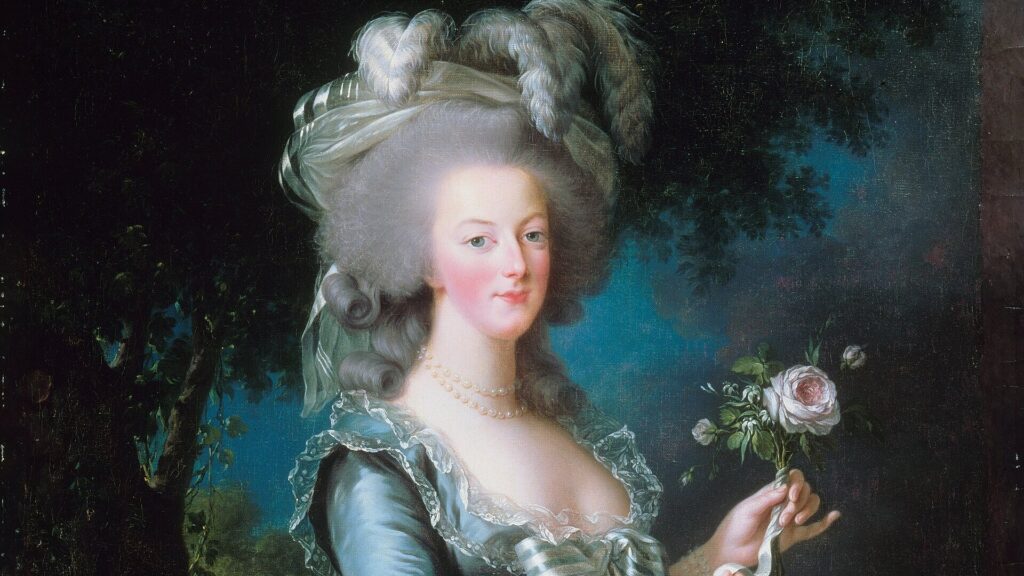
Featured image: Marie-Antoinette «with the rose», Élisabeth Vigée Le Brun, 1783 (detail), Palace of Versailles. Public domain, via Wikimedia Commons.