


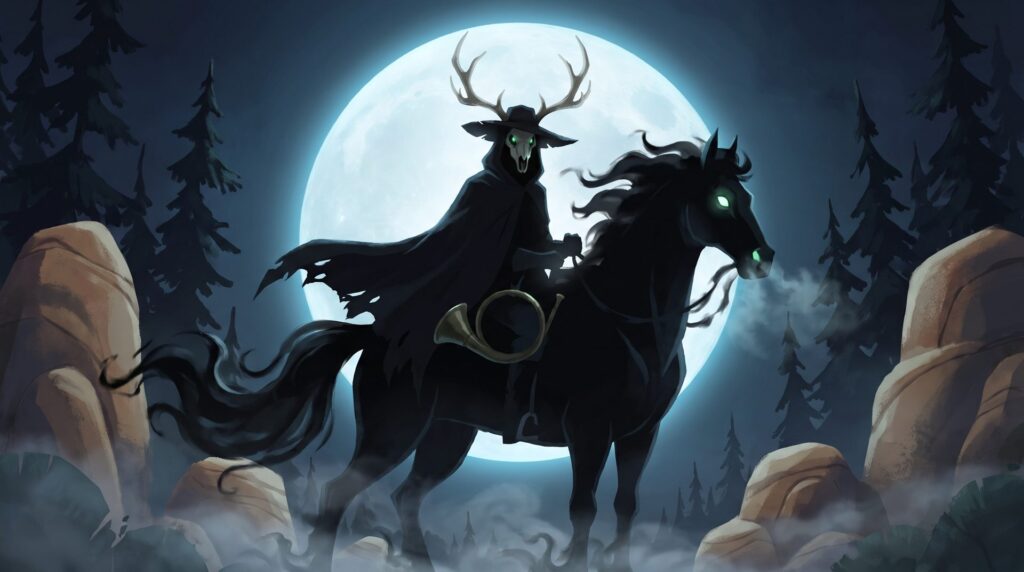
A pack you can hear but never see. A black horseman bursting out from between the rocks. And a King of France riding back to the château faster than he left it. To get you in the mood for Halloween and for all the events held in Fontainebleau for Halloween, here is the true story of the forest’s most famous ghost, and the music video for my Halloween song.
Who is the Grand Veneur?
The word comes from Latin venator, the hunter. Under the Ancien Régime, the Grand Veneur de France (Grand Huntsman of France) was a very high-ranking figure: created by Charles VI in 1413, the office placed the entire royal hunt under his authority: hounds, huntsmen and hunting crews. One of the most prestigious offices in the kingdom.
But in Fontainebleau, when people talk about the Grand Veneur, nobody thinks of the administration of the hunts. They think of the Black Hunter : a ghost on horseback galloping through the forest at night, followed by a pack of ghostly hounds, amidst a din of horns and barking. He doesn’t hurt anyone. He does far worse: he heralds misfortune.
1598: the night Henry IV heard the horns
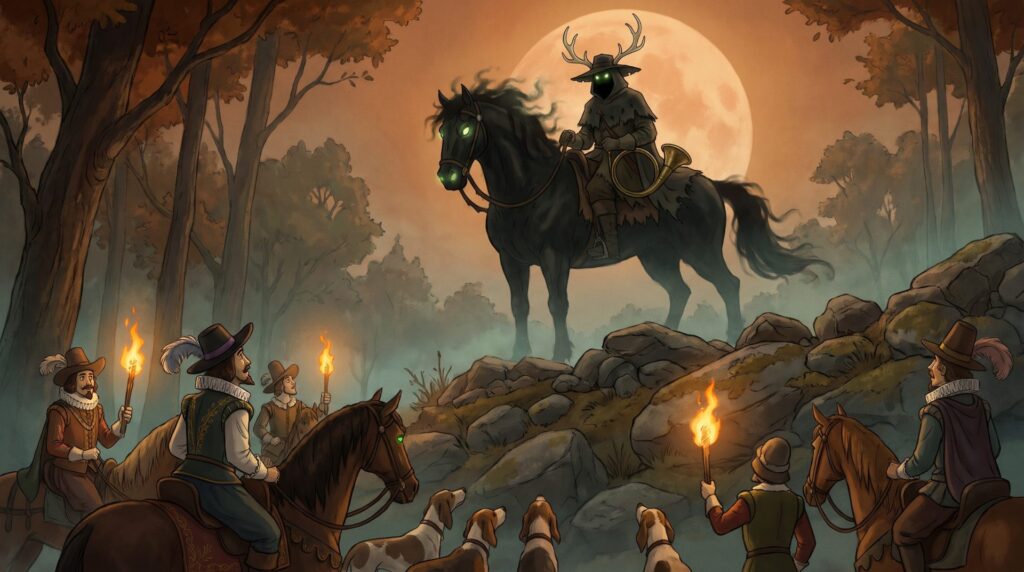
Image from the music video “Le Grand Veneur est revenu”, Fontyblog
It all begins in 1598. Henry IV, who had made Fontainebleau one of his favourite residences, is hunting in the forest. Suddenly, he hears dogs and horns close by, although no other hunt is planned. He sends the Count of Soissons to find out who dares to hunt on his land. The count comes back ashen-faced: he can hear everything, but see nothing.
Then a tall man dressed in black appears between the trees and calls out a phrase that no one has ever managed to report the same way. “M’entendez-vous?” (“Do you hear me?”) according to some. “Amendez-vous!” (“Mend your ways!”) according to others, which sounds a lot more like a threat. The chroniclers even recorded “M’attendez-vous?” (“Are you waiting for me?”) and “Qu’en pensez-vous?” (“What do you think?”). Then he disappears.
The most unsettling part? This story was not made up two centuries later. As early as 25 October 1598, the diplomat Jacques Bongars recounted it in a letter to the botanist Joachim Camerarius: the king, returning from the hunt at around ten in the evening, is said to have heard a hunter calling his hounds by name. When asked, the oldest inhabitants of the town reportedly told him that, in the dead of night, one could sometimes see a hunter on horseback with seven or eight hounds, roaming the forest without harming anyone. The episode is also reported in the Journal de L’Estoile, by the historiographer Pierre Matthieu and by Hardouin de Péréfixe. The date varies from one author to another, August or September 1598: ghosts don’t keep a diary.
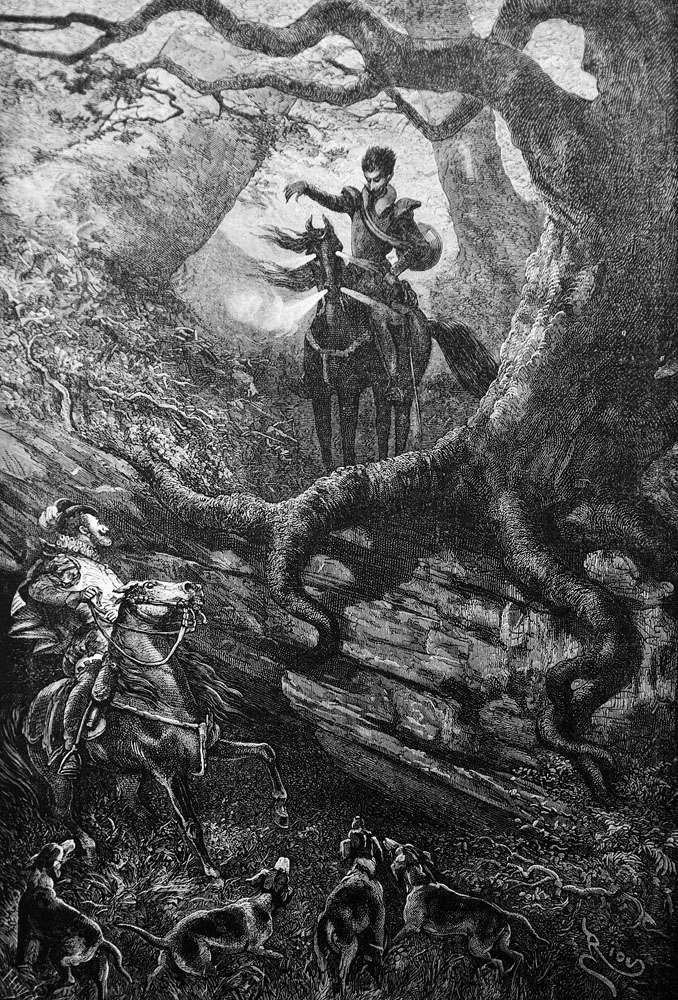
Édouard Riou, “La vision d’Henri IV” (The Vision of Henry IV), La Chasse illustrée, 1873. Public domain, Wikimedia Commons
A very bad omen for kings
It is what comes next that has made the Grand Veneur famous. Twelve years after the encounter, in 1610, Henry IV was assassinated by Ravaillac. That was all it took for the Black Hunter to become a harbinger of doom.
Traditions collected in the 19th century go on to credit him with a fine career as a prophet. He is said to have appeared shortly before the sudden death of the Duke and Duchess of Burgundy, in 1712. He is said to have foretold their end to Louis XVI, and later to the Duke of Berry, who was murdered in 1820. And some woodcutters are said to have spotted him the day before Napoleon’s abdication, in April 1814, at the Château de Fontainebleau. After the revolution of 1830, he was supposedly never seen again. But some forest wardens swore they could hear him sounding his horn on stormy nights.
Coincidences? Probably. But you have to admit it makes a better story than the royal hunting records.
Odin in the Forest of Fontainebleau?
For the historian Jean-Jacques Ampère, son of the physicist, the case is clear: the Grand Veneur is none other than Odin, the god of Norse and Germanic mythology, turned over the centuries into a Fontainebleau huntsman. The idea is not so far-fetched. All over Europe there are tales of the Wild Hunt, a ghostly hunt that sweeps across the sky or through the woods at night: Herne the Hunter in Windsor Forest, Hackelberg in Germany. Fontainebleau simply has the most royal version.
Another, even older version is also told: that of Francis I. Furious to see a stag escape him, the king is said to have shouted “Diable!” (“Devil!”) as he spurred his horse. A thick mist fell over the hunt, and a black hunter with eyes of fire brought down the stag right under his nose. Bongars, for his part, believed the ghost was the soul of a hunter killed in the forest in the reign of Francis I. The moral: in the Forest of Fontainebleau, mind your language.
Following in the footsteps of the Grand Veneur in the forest
The ghost left his name on the map. To the north-west of the forest, on the road to Barbizon, the Croix du Grand-Veneur (Grand Veneur’s Cross) marks the crossroads of the same name. It already appears on the oldest map of the forest, that of Nicolas Picart, dated 1624. Restored in 1670 at the expense of the Duke of La Rochefoucauld, rebuilt in wood in 1827 and then in sandstone in 1846, it has had an eventful life: knocked down in 1919 by a straw cart, then in 1926 by a car. Today it stands proudly in the middle of the roundabout built in 2000. The Grand Veneur himself has never been fined.
Another tradition, reported by BFM Paris, has it that he reappears every hundred years at the Croix de Montmorin. So a word to walkers planning their outing with my page on the Forest of Fontainebleau, and to climbers checking the map of open boulders : keep your ears open.
The Grand Veneur in film, on TV and in books
- Meurtres à Fontainebleau (Murders in Fontainebleau), a France 3 TV film broadcast on 29 August 2026, directed by Sandrine Cohen, starring Roxane Turmel and Antoine Hamel. A quad-bike rider is found dead, trampled by a mysterious horseman: what if the Grand Veneur had come back to protect his forest? Available to watch again on france.tv.
- Les Secrets du Grand-Veneur, a show staged at the Château de Fontainebleau in 2017, in which the ghost carries little Ernestine off to a cave inhabited by fairies and dragons.
- Les Contes du Grand-Veneur, by Romain Billot (2013), which turns the ghost into a character in children’s tales.
- Le Grand-Veneur ou Chasseur noir de la forêt de Fontainebleau, by Louis Ferrand (1979), the short reference monograph on the legend.
- Dictionnaire infernal by Jacques Collin de Plancy (1818), which ranks him among the demons.
What if he came back today? The music video
That’s the question posed by Fontyblog’s Halloween song, “Le Grand Veneur est revenu”. Four hundred years after sending Henry IV packing, the Black Hunter comes out of the woods once again. He is getting ready to spread terror. But Fontainebleau has changed.
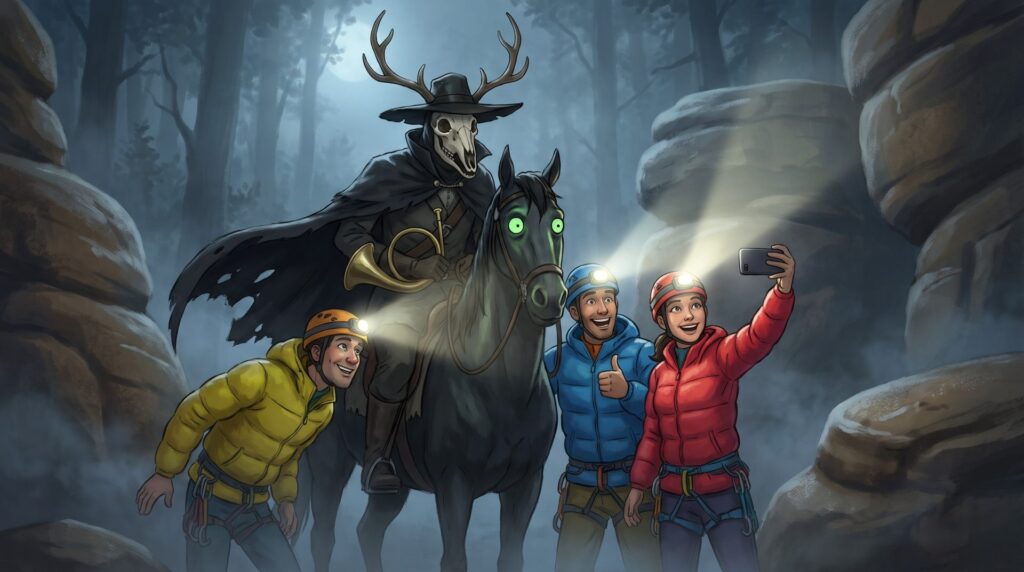
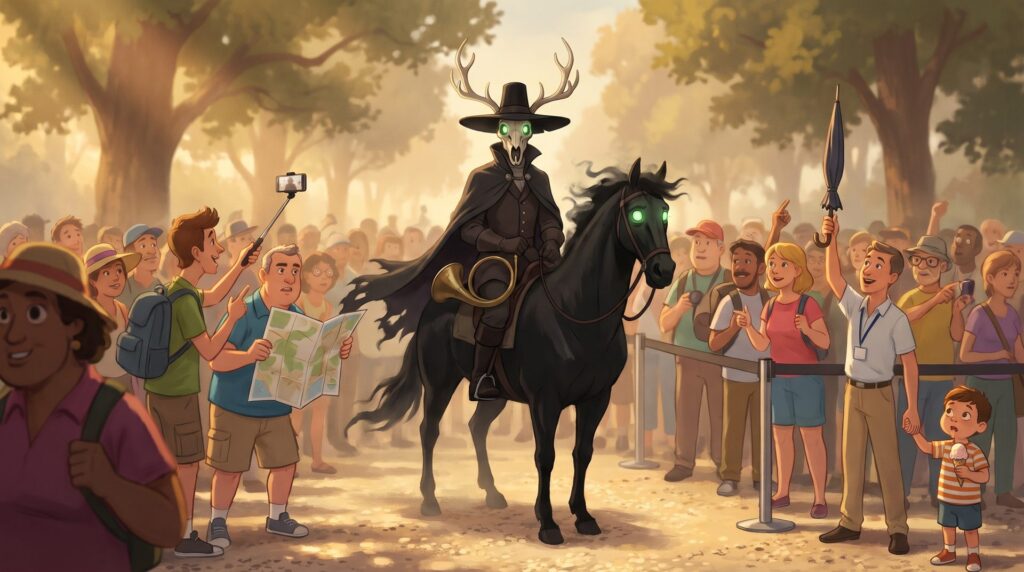
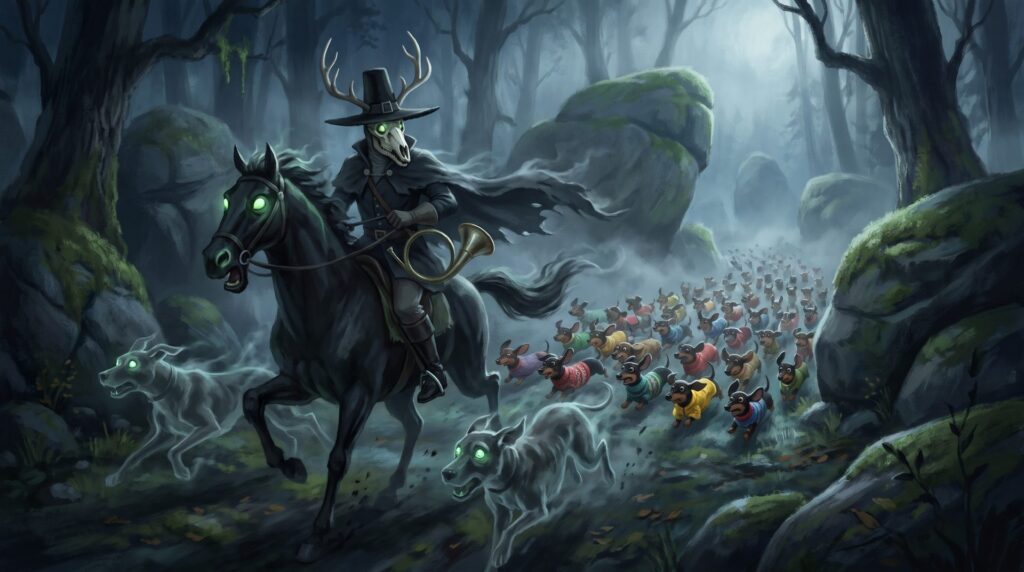
Stills from the Fontyblog music video “Le Grand Veneur est revenu”
Here is the full music video, animated and without a single shiver. Turn up the sound and share it with anyone who still thinks Halloween is scary.
© Emmanuel Parrou / Fontyblog
Don’t forget to follow Fontyblog!
Follow Fontyblog on social media so you don’t miss a thing about Fontainebleau.
And now that you know all about the Black Hunter, all you have to do is choose which evening to go: all the Halloween outings in Fontainebleau are in the events calendar, from the evening at the library to the shopkeepers’ sweet hunt. If you meet a black horseman on your way, take a selfie with him: he loves it.
Sources
- Jacques Collin de Plancy, Dictionnaire infernal, Volume II, Paris, Mongie, 1818, pp. 381–382.
- Jean-Jacques Ampère, Histoire littéraire de la France avant Charlemagne, Volume II, Paris, Didier, 1867, pp. 113–139.
- Abbé Guilbert, Description historique des château, bourg et forest de Fontainebleau, Paris, André Cailleau, 1731, pp. 197–204.
- Louis Ferrand, Le Grand-Veneur ou Chasseur noir de la forêt de Fontainebleau, Paris, Librairie d’Argences, 1979.
- Félix Herbet, Dictionnaire historique et artistique de la forêt de Fontainebleau, 1903, entry “Croix du Grand Veneur”.
- Jérôme Lachasse, “Qui était vraiment le Chasseur noir de la forêt de Fontainebleau ?”, BFM Paris, 23 July 2017.
- Grand Veneur (légende) and Croix du Grand-Veneur, Wikipédia (French).
- “Meurtres à Fontainebleau sur France 3 : la légende du Grand Veneur au cœur de l’enquête”, Série News, 29 August 2026.