


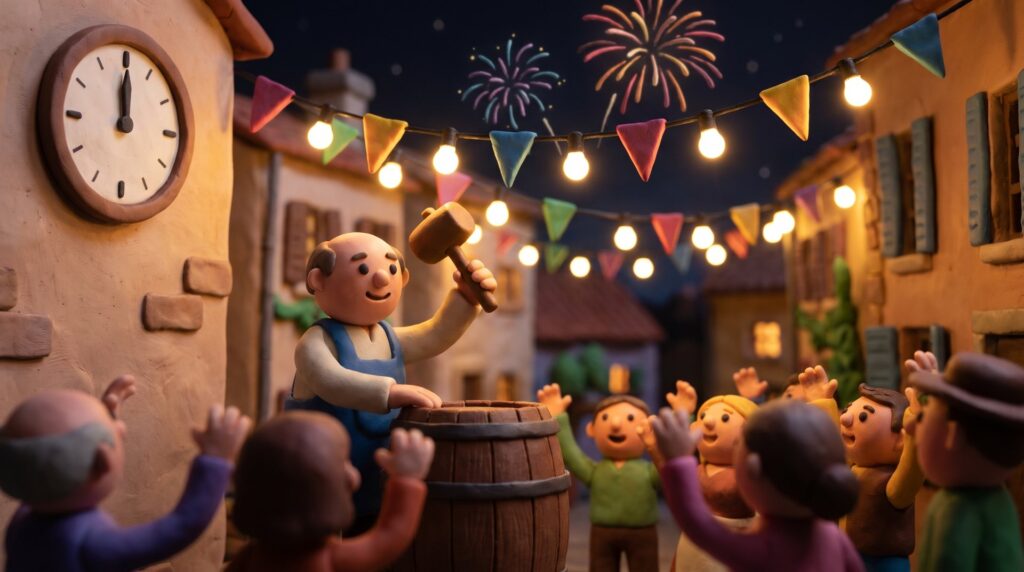
At midnight sharp on the night of Wednesday 18th to Thursday 19th November, the first bottles of the 2026 vintage will be uncorked.
Behind this impromptu meeting at the bar lies a ministerial decree, a dash to London,
a wine bath in Japan and a film starring Jean Carmet.
A wine born out of a power struggle with the authorities
It all begins with a ban. The 8 September 1951, a national decree prohibits the sale of appellation wines before 15 December following the harvest. The problem is that Beaujolais winegrowers are used to selling their bottles well before then.
They protest, and they get their way. An official memo from the 13 November 1951 allows them to sell it earlier, on one condition: that they write «nouveau» on the label. Beaujolais Nouveau was first produced just two days before the release of the 1951 vintage. This year, therefore, it celebrates his 75th birthday.
The idea itself is much older. Primeur wine has existed since ancient times, and as early as the Middle Ages, wine was already being sold around a fortnight after the harvest.
Illustration: Fontyblog
Why a Thursday, and at what time?
The release date initially varied from year to year, before the 15 November was set in 1967. There has been just one exception in the history of the wine: in 1977, unpredictable weather delayed the ripening of the grapes and the wine was released ten days late, on 25 November.
Next comes today’s rule. To ensure that the event no longer falls at a weekend, and to maintain a reasonable distance from the 11 November commemorations, the date has been changed to the third Thursday in November, since 1985.
And keep an eye on the time. The unlocking takes place at the very start of Thursday. In other words, it is on Wednesday evening, at the twelfth stroke of midnight, when the first corks pop – and not on Thursday evening. This year: during the night of Wednesday 18th to Thursday 19th November. The more sensible ones, however, wait for Thursday’s aperitif.
What’s in the glass
A single grape variety: the black Gamay with white juice, a grape variety with thin skin that is naturally low in tannins, which accounts for over 96 per cent of the vineyard. The grapes come from the Beaujolais and Beaujolais-Villages appellations, excluding the ten crus.
The secret lies in the vat. The grapes are harvested by hand, with great care taken not to crush the berries, and the bunches are placed whole into the vat. We are talking about semi-carbonic maceration : some of the grapes undergo carbonic maceration, whilst the rest ferment in the juice at the bottom of the vat. The result is a wine fruity, low in acidity, low in tannins, ready to drink a few weeks after harvest.
And what about that famous banana flavour?
It didn’t come from the grapes. In the 1970s and 1980s, many winegrowers used a laboratory yeast, the 71B, which produces the flavour found in banana sweets. It has all but disappeared from the vats over the past fifteen years or so.

Illustration: Fontyblog
Figures that make your head spin
Last year, Beaujolais Nouveaux accounted for approximately 13.8 million bottles, accounting for 21 per cent of the estate’s total sales. The French have drunk it 9 million, and 4.9 million have gone to more than 100 countries.
Le Japan remains the leading market, with 1.8 million bottles, ahead of the United States, the United Kingdom, Canada and Belgium. And that is nothing compared to the golden age: in 2004, Japan imported more than 12 million bottles. In the late 1990s, a total of 450,000 hectolitres were sold, compared with 120,000 today.

Illustration: Fontyblog
How we celebrate it
In the heart of the vineyard, the big event is called Les Sarmentelles de Beaujeu. For the 38th edition, from 18 to 22 November, the «tapping» of the first barrel takes place on Wednesday at midnight sharp in the Town Hall Square, accompanied by a torchlight procession, fireworks and a grand ball. The whole event relies on around 300 volunteers.
Elsewhere, it is the time difference that determines the order of release. As the wine is only released at midnight local time, it is the Asian time zones that are the first to raise a glass, hence the annual footage from Tokyo on the television news. In the United States, Beaujolais Nouveau Day arrived in 1983, and the wine is often served at Thanksgiving, more for its release date than for its pairing with turkey.
The stories we tell each other at the bar
The journey to London
On 18 November 1970, during a dinner in Romanèche-Thorins, the wine merchant Joseph Berkmann and the journalist and politician Clement Freud set each other a challenge: who would be the first to bring Beaujolais Nouveau back to London? Berkmann won the first two races. In 1974, the Sunday Times set the same challenge to its readers, and the race took off. Throughout the 1970s and 1980s, the aim was to be the first to deliver a bottle to the journalists on Fleet Street. The race still exists today, having been transformed into a navigation rally, and is now run in the opposite direction.

Illustration: Fontyblog
The Beaujolais Bath
It’s THE photo that pops up every year: Japanese people toasting in a wine-red pool. It comes from the Yunessun spa complex in Hakone, whose wine bath is approximately 13,000 litres has been operating since 2005. A small detail that dispels the myth somewhat: at the time of the Beaujolais Nouveau release, they pour about six bottles a day. A symbolic volume.

Illustration: Fontyblog
The film
In 1978, *En 1978 sort* was released The Beaujolais Nouveau has arrived, a comedy by Jean-Luc Voulfow starring Jean Carmet, Michel Galabru and Pierre Mondy, based on a novel by René Fallet. The story? The Beaujolais Nouveau hasn’t arrived at the bistro, so the whole neighbourhood sends three friends off to fetch it.
The Pope of Beaujolais
It’s impossible to tell this story without Georges Duboeuf. Nicknamed the «Pope of Beaujolais», this wine merchant from Romanèche-Thorins is regarded as one of the founding fathers of Beaujolais Nouveau. Legend has it that he started out cycling, laden with bottles, to sell his wines to restaurants in Lyon. He died in January 2020, aged 86.
The Third River
Lyon loves this wine so much that one writer described it as a third river flowing through the city – a river of red wine that never runs dry.
What about the 2026 vintage?
An extraordinary year. The grape harvest has begun from 13 August, one of the earliest in the vineyard’s history, and the harvest is significantly down. By way of comparison: the start of the harvest was on 19 August in 2025 and 6 September in 2024. The verdict, however, will be revealed in the glass, from midnight on Wednesday.

Illustration: Fontyblog
So, at midnight on Wednesday for the most eager among you, or over an aperitif on Thursday for the rest: in Fontainebleau, pop into a wine shop or a bistro, and raise a glass to 75 years of tradition. Cheers!
Excessive alcohol consumption is harmful to your health. Please drink in moderation.