



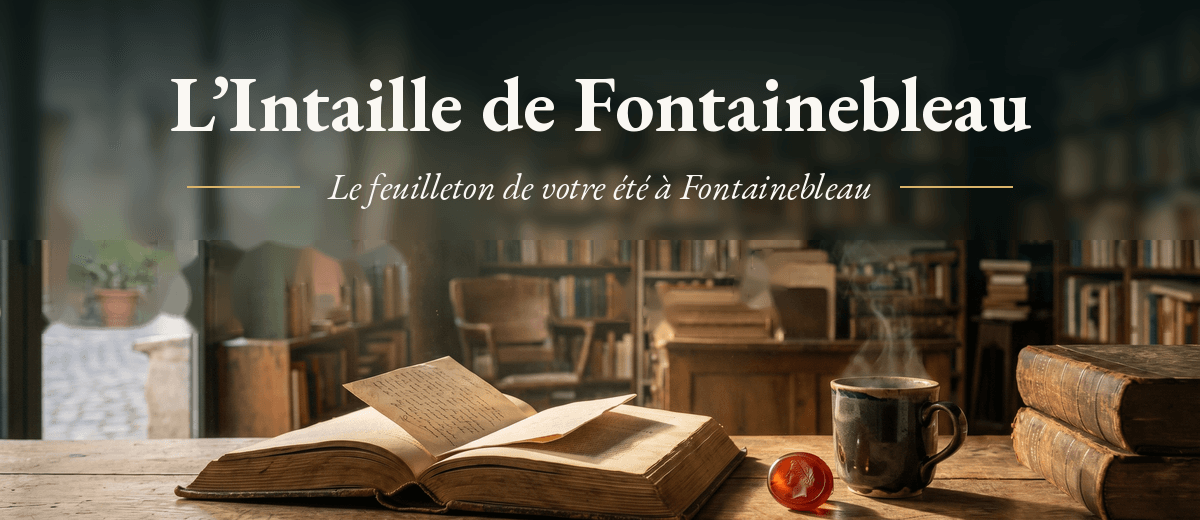
The Fontainebleau Intaglio
Episode 1Sénéchal
I’ve been here for three and a half weeks, and I still haven’t found the right place for the broom. Last night, I’d left it leaning against the back door – a sign of weariness. This morning, when I arrived, I nearly hit myself in the chin with it. My great-aunt Léonie used to write everything down in notebooks; I know this from my mum. The ‘tidying-up’ notebook is bound to be lying about somewhere in the shop, between a 1962 Larousse and an old Blue Guide to Spain. I’ll find it one day.
7.20 am. The coffee’s ready; I draw back the curtains and place the «Open» sign on the display table. The first cyclists ride down Rue des Sablons, unhurried, heading towards the station. Every morning I tell myself I’m going to set up a chair outside to watch them. Every morning, I go back inside and sit behind the counter.
The air, in June, at seven o’clock, has the texture of freshly printed paper. Still warm from the press. My old job taught me to see a pavement as a stage, to count the terraces as they fill up, to note which shop opens five minutes before the others. Here, I’m unlearning all that. I take out the wicker basket of one-euro books for the secondary school pupils, arrange a stack of contemporary poetry that no one will pick up but which I love to look at, I pour my first coffee into a cup that’s far too big – Aunt Léonie’s, with a handle that’s broken and glued back together with epoxy. I’m a new bookseller. I’m beginning to realise that I’m not quite one yet.
At 8.20, a woman comes in, hesitates in front of the new arrivals table, picks up a Vargas, turns it over, puts it back, and leaves. That’s the third Vargas to have been put back this week. I’m not yet sure whether I should move the pile back or bring it forward. Aunt Léonie would have known. Aunt Léonie died in February, without leaving any instructions, which seems typical of her as far as I know her.
Camille turns up at about eleven, wearing a smock, a bag in her hand and looking as though she won’t be staying long.
— Sénéchal, she says. I can't stay. Twenty minutes, watch in hand.
She sets the bag on the counter. Cherries. Mum's cherry tree is groaning with them, she adds. You'll be eating these all week.
— I’m going to eat them all by myself, Camille. Don’t overestimate how long it’ll take me – I’m not sure I’ll leave any for Hugo.
She laughs quickly, with a wry smile. Camille is a nurse at Fontainebleau Hospital, and even during her break she seems to be running the whole ward on her own. I pour two coffees without asking, because she won’t ask. She clambers onto the stool.
— You look well, I must say. The fresh air suits you.
— It’s the new boss’s worry. I’m not sleeping well.
— You didn’t sleep well in Paris either. At least here it’s lovely when you wake up.
We smile at each other. She lowers her eyes to her cup, raises them. Lowers them again. Her spoon stirs two turns too many.
— Bruno's taken five night shifts this month.
— Five.
— Five, yes.
She says it without leaning on it, the way you'd announce the weather. I've known her since we were eight; I can see her coming even when she says nothing. She goes on, without looking at me:
— Léo turned seven last week. Bruno had promised to be there for the cake. He phoned at seven o’clock to say he was run off his feet. Léo didn’t say a word – that’s what really got to me. Last night, as he was falling asleep, he told me it didn’t matter that his dad wasn’t there for dinner. It doesn’t matter. Can you believe it?
She stops, smiles to let me know she’s not going to carry on, and carries on.
— I was wondering whether it wouldn't be simpler just to… well.
The «voucher» falls flat. She looks at the pile to the right of the till and changes the subject.
— Bought more stock?
— A lady from Massy cleared out her father's library. Six boxes. Not all worth keeping, but there are two or three gems.
— You still have the time, you, to look at things like that.
— That’s my job, Camille.
— You’ve only been doing this job for a short while.
She says it in a friendly way, but she means what she says. She nods, drinks her coffee – which is too hot – and puts the cup down.
— Right, I’m off. I’m on from 2.00 pm to 10.00 pm tonight.
She gets up, grabs five cherries for the road, gives me a quick kiss and runs off.
I rinse the two cups. At the bottom of hers, a layer of sugar has settled. Camille had put sugar in her coffee this morning. She who never puts sugar in her coffee.
The lady from Massy’s pile takes up half the table. It’ll take me the whole week. I sort through it in the early afternoon, with a cold coffee within easy reach and a pencil tucked into my bun. The rule is simple. On the left, the ‘new-in-disguise’ items, to be put back on the shelves with a second-hand price tag. In the centre, the heritage items, which will go into the collection. On the right, the unsellable items, to be left for anyone to take from the bin on the pavement.
By the third box, I take a break. The coffee has gone cold, so I reheat it and move on to Léonie’s personal collection on the shelf against the wall. Two hundred volumes, which I’ve been cataloguing in batches of ten for the past three weeks. I take out a bound volume by Mérimée, medium-sized, in green half-shagreen, with a faded spine. The title page is annotated in Léonie’s black ink. No stamp, no price written in pencil. The personal collection was kept separate from the general stock. I’m beginning to understand that.
I open it, out of an archivist’s instinct to see where it creaks. Page one hundred and four: a sheet folded into quarters. Thick, laid paper, perhaps ten years old. Léonie’s handwriting, hasty this time. Not the neat calligraphy of the dedications. A working note.
Carnelian, profile facing right, eighteen by fourteen millimetres, yellow gold setting with barley-grain finish, Greek signature comprising two characters with lower angles, in fresh condition. Napoleon I Museum, display case 12. On the same line, closer together, as if added later: to be checked, do not.
The «not» hangs in the air. No comma, no continuation. Léonie wrote a great deal, organised little, and, it seems, rarely finished anything. I never had a proper conversation with her. Three or four family lunches, spaced out, pleasant, brief. Each time, she’d say to me: ‘Iris, you’re just like me, only more tense.’ And I’d laugh.
I’m reading it again. Léonie saw the item in the shop window, she noted it down in detail, and she wrote at the bottom that something needed checking. And that she shouldn’t do something else. Without saying what.
I fold up the sheet of paper. I put it in the drawer under the counter, beneath yesterday’s envelopes. I’ll tidy it away properly this evening. A note slipped into a Mérimée isn’t, in itself, a big deal.
Hugo arrives at a quarter to three, carrying a bag that’s too big for his back. He shoves it under the counter, takes out a folder and places it in the coffee corner.
— Just so you know, I’ve got a public law lecture at 7 pm. If you want me to close up, I’ll have to pop out at 6 pm.
— You dash off at six. I'll stay on a bit after.
He nods, picks up a book from the pile in the middle, puts it back, then picks up another one. There’s a way he handles the books, as if he were returning them to themselves. It’s a detail that took me ten days to notice.
— Did you practise for your oral exam last night?
— I fell asleep on my revision notes. If I fail the oral exam, I’ll tell the teacher it’s your fault.
— Very good. I'll tell her you mix up Tocqueville and Talleyrand.
— Ha ha.
He laughs, genuinely, baring a back tooth.
— Did you speak to Mrs Vilars this morning?
— Madame Vilars?
— The lady from Rue Royale comes round on Tuesdays at ten o’clock; she always buys two bottles of Modiano, never the same one. She’s got a bottle of Modiano to buy before the end of spring; that’s what she told me last week.
— Didn't see her.
I’ll make a note of that. Tuesday, at ten o’clock: Mrs Vilars, two Modianos. The Institute of Political Studies in Fontainebleau – ‘Sciences Po’, as the locals call it – is just a stone’s throw away. It taught him how to file, though I believe he was already doing that.
I like closing up after Hugo. Checking the shelves, straightening a shelf, tidying away yesterday’s envelopes with the folded note inside, which I slip further in, without thinking. At seven o’clock, I draw the curtain and turn the key. Outside, the air has warmed up. Rue des Sablons breathes, emptied of its last passers-by, like all the streets that have been given back to pedestrians and forgotten by cars.
It was at the end of the street, near the square, that I recognised her. She was coming out of a carriage entrance – one of those large building entrances you never really notice – and stopped on the doorstep to make a phone call. First, her coat. A clean-cut style, tailored for somewhere else, just a touch too smart for a street in Fontainebleau in June. Then her profile, turned slightly to one side, the phone resting flat in her open palm, facing upwards, held in place by her thumb, index finger and middle finger – that gesture that nobody else makes except her.
Above the door, a plain sign, the sort you’d see for a shared workspace, offering offices by the hour or by the month. I know these places. You don’t just happen to end up there. You rent a space, you come back, you settle in. My eye takes it all in out of old habit, even before I’ve decided to pay attention to it.
I stop. She doesn’t see me. She puts her phone away and turns the corner onto Rue de la Paroisse.
Tonight, I'm not going home by the square.
Episode 2The Name
Wednesday, 7.10 am. I didn’t sleep any better than the night before, except that this time I know the reason, and I spend part of the night trying to convince myself that I don’t.
The coat. It was the coat that did this to me. A crisp, chic cut, just a little too smart for a street in Fontainebleau in June. But coats like that – ten of them get off the train at the station every time; that’s actually why people come here, to wear Paris in a setting that forgives them. And the phone lying flat in an open palm, turned towards the sky, held in place by the thumb, index finger and middle finger – that gesture, I’ve seen it a thousand times. You end up believing that a tic belongs to a particular person. That’s not true. Tics circulate just like coats.
I draw back the curtains. I place the sign on the display table. Last night, I came home via the other route – Rue des Bouchers and Rue de la Corne – the longer way round that avoids the square. This morning, I’m not going to ring her. In my old address book, there’s a number I could dial to find out in three words whether she’s in Paris this week or somewhere else. But calling would be admitting that I’ve seen her… My thumb hovers over the phone. I tuck the phone away under the till, screen against the wood.
There you go. It was a coat.
At nine o’clock, Monique pushes the door open without letting go, one hand on the door, the other holding two cups.
Monique runs the café and tobacconist’s next door, the one whose sign creaks when there’s an easterly wind. In three weeks, I’ve realised that her shop and mine share a wall, a gutter and all the latest news from Rue des Sablons. She puts one cup on my counter and keeps the other.
— I've made you a long one. You, now, you take it short and strong, anyone can see that. Your aunt took it strong too, and there you are…
She doesn’t finish her sentence, which, for Monique, is a figure of speech. Léonie died of a heart attack one Sunday; the coffee had nothing to do with it, but Monique has a theory about everything and she likes to let people know.
— Your cousin from Bourgogne, she asks, did she end up moving?
My cousin from the Yonne. I mentioned her once, in passing, a fortnight ago. Monique puts people into pigeonholes and never misses a single one.
— She's still looking, I say.
— People are always on the lookout. Take yesterday, for instance: two Parisians who wanted a country house with exposed beams, fibre-optic broadband and mobile coverage. I told them, ‘We’ve got the beams; you’ll have to sort out the rest yourselves.’.
She laughed to herself at her own retort, pleased with herself, then let her gaze sweep across the shop – the pile on the table, the wicker basket.
— ‘You should put the novels near the door,’ she said. ‘People come in for a novel, they leave with a novel. Your aunt used to put the poetry at the front. Nobody comes in for poetry.’.
— ‘I quite like it,’ I said as I went in.
— That’s you.
She nods as she looks at a building site she’s only half-convinced by, then sets off again, cup in hand, and calls out from the doorway:
— A lady came by last night, after you’d closed. She stood looking at your shop window for quite a while. She’s not from round here. Have a nice day, Iris.
The door closes. Not from here. In Fontainebleau, that’s not just a piece of information – it’s half the clientele.
A lady standing in front of my shop window one evening, after closing time. Nothing to get worked up about. I keep telling myself that, and yet I know full well that I’m making a big deal of it, with a coat, a carriage entrance and a timetable.
Where I come from, we never asked a question unless we already knew what we’d do with the answer. That was her speciality. The gentle question, asked as if it were nothing, and the trap already snapped shut whilst you’re still searching for the right words. If I ring her this morning to pick her up, she’s the one who wins, from a distance, without even realising it. I’d rather believe it’s just a coat.
I know this scenario all too well, having been through it myself. One morning, I was told – in carefully chosen words – that my role was changing, and that it was an opportunity. I nodded, because I’ll never forget that smile as they move you along – with a stroke of a pen on the organisation chart, a note scribbled on a hastily printed Excel spreadsheet. It took me three months to realise who had been holding the pen. And that person, perhaps, this very morning, is walking up a street in Fontainebleau, mobile in hand, palm raised to the sky.
Or perhaps not. Perhaps I'm lending a passer-by the outline of the one person I don't want to see here. I pour myself more coffee. It's gone cold. So much for the coffee.
The lady arrives just after eleven. I recognise her before she speaks, by the way she holds the door open for a second too long, as if hesitating to enter a room where she’s left something behind. It’s the lady from Massy. Six boxes: her father’s bookcase, cleared out one Saturday. That day, she’d counted the notes without looking and left without taking off her sunglasses, in a hurry to get it over with. Today, she’s taken off her sunglasses, and she’s in no hurry.
— I was wondering, she says. My father's books. Do you still have them?
— Sort of. I’ve sorted through them. The rest are over there.
I point to the table. She doesn’t go near it; she looks at the piles from a distance, the way you look at a photo of someone you don’t want to see up close again.
— My father used to slip things inside his books, she says. Bits of paper. He'd jot things down, fold them, forget them. We found a shopping list in a Montaigne.
She said this, looking not at me but at the wall behind me, where Léonie’s back shelf runs along. Barely a second. But I’ve learnt to recognise a remark that seems to come out at random but has actually been carefully considered. The real detail, the shopping list, placed there to make the rest seem real. And a glance directed over my shoulder whilst someone is talking to me about something else.
She smiles, and the smile doesn't hold.
— If I come across any sheets, I'll put them aside, I say. I do it for everyone.
— Have you found any?
The question springs to mind, clearer than anything she has said so far. I think of Léonie’s note, tucked away in the drawer. But that piece of paper didn’t come from Massy. It comes from my great-aunt’s collection, from a Mérimée who never left this shop.
— Not in your boxes, I say. Not yet.
She looks at me a second too long, she does too.
— No, she says. No, of course not.
She lets a moment go by, then, in the same light tone:
— She noted everything down, your aunt. In the margins, on index cards. Did she leave you her notebooks?
— I'm still sorting, I say. Things turn up every day.
— Things always turn up.
She takes a few steps. Not towards the table where her father’s books lie. Towards the wall, towards the shelf containing his personal collection, the one where Mérimée’s book lay. She stops in front of it, her hands behind her back, without touching anything.
“That’s lovely, what your aunt has kept there,” she said.
I never said that this shelf was any different. Nothing on it has a price tag, nothing has a stamp on it, and you have to be familiar with the shop to know that.
— You knew Léonie, I say.
That’s not a question. She turns round, and for the first time she really looks at me, for a long time, as if assessing what the other person has already understood.
“Everyone knew your aunt,” she said. “She was a bookseller.”.
She picks up her bag again and makes for the door.
“I’ll pop round again for the leaves,” she said. “If there are any.”.
On the threshold, her back already turned, she adds:
— You look just like your aunt. That’s funny.
And she's outside before I can think of anything to say.
The door closed with a soft click, and it was only then that things fell into place, with the usual delay. She hadn’t so much as glanced at her father’s boxes. She’d come for the wall, for Léonie’s shelf. The rest was just small talk, to keep up appearances, the sort of thing you do when you want to divert attention.
I open the notebook where I make a note of who redeems, who deposits, and who will return. On the line for the first day, where the name should have been, I’d written ‘Massy’, followed by a blank space, as one leaves a place for someone who will eventually turn up. The space has been waiting for three weeks, and this morning I realise it wasn’t an oversight on my part. It was she who never filled it in. One mentions a town rather than a name, just as one speaks of a father and his books rather than a bookshelf and a dead woman.
The line remains blank where the name should be. I close the notebook. Tomorrow, either I’ll go down to the square to see if the coat turns up again, or I’ll write a name on that line. Tonight, I don’t even know which of the two scares me the most.
Episode 3The regular
Thursday, eight o’clock. Last night, I promised myself I’d do two things this morning, and I won’t be doing either of them.
The first was to go down to the square in case a certain coat turned up there again. The second was to finally write a name on the blank line in my notebook, in place of that lady who unpacked six boxes at her father’s house and never gave me hers. Two debts I’ve incurred with myself. I already know I’ll put them off, just as I’ve been putting off oiling the hinge on the back door for the past three weeks.
At eight o’clock in June, the air smells of bread from the nearby bakery and, just a little, of wet stone in the morning. I do what I now do every day. I make my coffee, draw back the curtains, and place the sign on the display table. Then, without really meaning to, I open the drawer under the counter, lift out the envelopes from the day before, and check that the folded piece of paper is still there. Aunt Léonie’s note. Carnelian, display case 12, to be checked, don’t. I touch it with my fingertip, as one might press a bruise to see if it still hurts. It doesn’t do anything. It’s just a scrap of paper in a drawer. I close it.
Eight forty. The phone vibrates against the wooden worktop. It’s Camille.
— Seneschal. I hope I haven’t woken you.
— I've been up since half past six.
— That’s exactly what I’m saying. You never really sleep.
The reason for her call is trivial. She wants to know if I’ve finished her mum’s cherries, because there’s still a whole treeful left and nobody at her house is eating them.
“Does Bruno not like cherries?” I asked.
— Bruno eats at all hours. Bruno eats in the car, between shifts. But he doesn’t take anything from home with him when he goes to work.
The children see him in the morning, she adds, and more than that. Léo had drawn him a picture and put it on the windscreen to make sure Bruno saw it. Léo found it soaking wet; it had rained during the night. ‘He told me about it with a laugh,’ says Camille, and she laughs too, to round off the story and stop it from getting out of hand.
A silence. Not a long one. But I heard it – that one – because I spend my life listening to other people’s silences, and this one had depth.
— “And how’s the shop going?” she pressed, because it’s easier to talk about other people than about yourself.
— It’s getting off the ground. People come in to escape the sun and leave with a book. That’s something, at least.
— You see, you're made for it.
She says it to please me.
— And you, are you all right? I ask.
— I’m fine. Why wouldn’t I be?
It all happened too quickly. A question in reply to a question – the old sleight of hand, the one you use when you don’t want to lie but don’t want to say no either. The day before yesterday, she’d left a sentence hanging there on her kitchen table, and over a little boy who says nothing. This morning, she’s buttoned it all back up. That’s the natural order of things. You open up once, you feel ashamed, then you shut yourself off again.
— I finish at 10 pm, she continues, and tomorrow I’m back at 6. You know how it is, you barely get a wink of sleep.
She says that about her job, but it’s not her job she’s talking about. I know that way of laying her tiredness out on the table so that people look the other way. At the hospital, she helps people who are falling to their feet. At home, she’s the one who’s faltering, and nobody sees it, because a nurse, by definition, is someone who holds things together.
I ought to insist. I’m not insisting.
— You know you can come round, I say. Whenever you like. The sofa's bad, but it's yours.
— I know. It’ll be a chance to bring you some cherries, perhaps.
She hangs up first, as always. And I’m left holding the lukewarm phone in my hand, with the distinct feeling that I’ve missed something—again. It’s something I’m particularly good at. I see everything, except at the right moment.
Half past nine. The bell rings. Olivier Fontaine walks in, his white apron still tied under his jacket, which means he’s left his kitchen between two deliveries just to come here. Olivier runs a bistro three doors down from mine. He’s the only man in town capable of recognising a customer he served just once, three years ago.
There’s already a lady in the shop, browsing through the new arrivals. Olivier looks at her for a second, tells her he’s making his risotto without Parmesan for lunch today, and she seems pleased that someone’s taken an interest in her. Then he turns to me, and his smile fades a little, because he’s got nothing to sell me.
— I’m looking for a book for Sylvie. Something lovely and not too sad. She’s been revising all summer, so she deserves a bit of light-hearted reading.
Sylvie is his wife, a primary school teacher, and Olivier speaks of her as if she were a country he loves to return to. For a moment, I envy him—the way he knows exactly where he belongs. I suggest three songs to him. He weighs them up as he might weigh up tomatoes, and keeps one without hesitation.
“What’s good to eat at the moment?” he asks, casually, as he puts down the change.
— I nibble at things.
— ‘Nibbling’ isn’t an answer.
He doesn’t press the point. That’s Olivier’s way. He asks the question, leaves you to think about it, then walks off. He slips the book under his arm, tells me to pop round one evening – the table at the back is quiet – and heads back to his pots and pans. The shop smells of warm butter a minute after he’s left. It’s the last light-hearted moment of the morning, but I don’t know that yet.
Ten o’clock. The bell rings, and even before I look up, I know it’s Monique, because Monique doesn’t just walk into a shop – she bursts in. The café-tobacconist’s next door can’t manage three minutes without her, just long enough for her to come and unload here what she’s gathered there.
— Have you heard? she says.
— Heard what?
— A death.
She lets the word drop the way she hands back change, without hesitation, sure of her count.
— This morning. Near the Château. A man. Apparently, he was found early on, on a flight of stairs or in the gardens – it depends on who you ask. The police were there before the château opened to visitors.
— Who? I say.
— Ah, that’s a mystery. We don’t know yet, or perhaps we do but are keeping quiet. A visitor, in any case. Not from round here. Someone who used to come often – a regular, they say – always on his own, always in the same rooms.
The Château. Still in the same rooms. I say nothing, and in my mind, without my even calling for it, the drawer opens again. The sheet of paper. Carnelian, display case 12, to be checked, or not. A note I’d tucked away as one might tuck away a curiosity, a whim of a learned old lady—the sort of piece of paper you find in old books and keep out of affection rather than for any practical reason.
“Does that mean anything to you?” said Monique, who is far better at reading people’s faces than she lets on.
— No. It’s just early, for a dead person.
— There’s no set time for that, my dear.
She leaves as quickly as she came, heading for other bars and other ears, because news like that isn’t kept to oneself – it’s passed on. The door closes on the silence she always leaves behind, the kind that lasts just long enough for us to understand what she has just said.
I’m standing behind the counter. My hand is in the drawer. I didn’t choose to put it there; it’s just there, resting flat on the folded sheet of paper, as if holding onto something that might fly away.
A man used to come to the Château. Often. Always to the same rooms. And in my drawer, for the past three weeks, a dead woman has been describing a specific object on display in one of those rooms, and has written underneath that something needs to be checked, and that it mustn’t be done again. Without saying what.
This morning, I’d promised myself I’d sort out a coat or a name. Little fears of my own, fears born of comfort. All of a sudden, they seem far away.
I’ve learnt to sense the exact moment when a rumour ceases to be a rumour. It makes no sound. It’s just that you can no longer put it back where you found it.
My name is Iris Sénéchal. Yesterday, I kept a note in a drawer because I couldn’t bring myself to throw it away. This morning, I’m keeping it because I can’t bring myself to put it back.
Episode 4The Warrant Officer
Friday, half past seven. The night didn’t help matters. I slept fitfully, and every time I woke up, the same thought was waiting for me, perched on the edge of the bed like a patient cat: a man was coming to the Château, always to the same rooms.
I woke up having already made up my mind. I’m not getting involved. I’ve got a bookshop to run, a collection to catalogue, a friend who’s struggling and whom I’m not helping – that’s quite enough on my plate for a woman who sleeps poorly. The death of a stranger at the Château is none of my business, and Aunt Léonie’s note is a coincidence – just an old lady who liked to pepper her descriptions of objects with personal comments. I know how to recognise a decision made to reassure oneself rather than out of pure reason. Staying out of it is certainly a decision aimed at reassuring myself, and yet I make it all the same.
The coffee’s on. I’m not touching the drawer this morning. It’s my way of keeping my distance.
Nine past ten. The door opens unhurriedly, and it is the uniform I see before the man himself. Chief Warrant Officer Garnier crosses the threshold as he does everything – without haste – taking off his kepi because one removes one’s headgear when entering a building. Mathieu Garnier is a gendarme in Fontainebleau; he comes once a week to have a coffee and a pastry in my coffee and tea corner, and that’s about all I know about him after three weeks, apart from the fact that he addresses everyone formally, and that I do the same in return, because one doesn’t use the familiar form with a uniform one barely knows, however friendly he may be.
— Madame Sénéchal. I am not disturbing you.
— You never disturb me, Warrant Officer. Do sit down, I will get you a coffee.
He sits down. He takes a small spiral-bound notebook out of his pocket and places it on the table without opening it – more out of habit than by design. I pour him his coffee. I already know he’ll forget about it, that he’ll let it go cold whilst he’s talking, and that he’ll drink it in one go as he’s leaving, as if it were medicine. For several long minutes, he stares at the people walking past the shop window without really looking at them.
— You will have heard, about the gentleman at the Château, he says.
That’s not a question. With Monique as his neighbour, everyone knew before he did, and he knows that.
— I’ve heard about it, I say. So it’s true, then.
— That’s true.
He says this calmly, without adding anything else. He is a man who leaves a pause after his sentences, and for him, silence is a tool. I’ve spent fifteen years watching people choose their words in front of microphones; I recognise someone who weighs up his own. He doesn’t say ‘accident’, he doesn’t say ‘mishap’, he doesn’t say ‘fall’. He says nothing of all the things that Monique, for her part, is already asserting.
He turns his notebook towards him and opens it to a page that has already been written on.
— Just a routine question, he says. We are trying to find out where this gentleman spent his time these last weeks. Yours is the only antiquarian bookshop in the centre. A lover of the Château often ends up at your door.
There it is. The question is put, gentle, almost offhand, exactly the way one puts the ones that matter.
— A great many people come in here, I say. I do not remember every face. I am new; I have known my regulars for three weeks, no longer.
— Of course.
He closes the notebook. He doesn’t quite believe me, but he doesn’t press me for an answer, because pressing someone isn’t his style. He drinks his coffee in one go – cold – stands up, and puts his cap back on.
— ‘If a name or a face comes to mind, let me know,’ he said from the doorway. ‘It’s not urgent. Nothing is urgent until we know whether something actually is.’.
And he walks out, without running, because Mathieu Garnier never runs – I’d stake my life on it.
Garnier had barely left the bookshop when Monique pushed open my door, and I realised she’d been keeping an eye out for the uniform from her till, because nothing that happens in her corner of Rue des Sablons escapes her notice.
— ‘He came to see you,’ she said, half as a statement, half as a reproach, as if I’d received him without her.
— He has his coffee on Fridays, Monique. You know that better than I do.
— On Fridays, yes. But once the notebook’s out, that’s not the café.
Monique sees everything, and whatever she doesn’t see, she makes up with such confidence that it ends up sounding like the truth. She leans on the bar, lowering her voice as if sharing a secret that’s already been all over town.
— As far as I’m concerned, what I was told was that he’d fallen down the staircase in the small flats – the one they don’t show visitors. What on earth was he doing there, I ask you? You don’t just happen to fall down a staircase where you’ve no business being.
She’s right, and that’s what bothers me. Monique says out loud, in her usual blunt way, what Garnier spent a quarter of an hour trying not to say. Rumours spread faster than the investigation, and sometimes they hit the mark more accurately.
— You are embroidering, Monique.
— Embroidering, embroidering. We will see who is embroidering once we know.
She leaves, glad to have got that off her chest, and the shop slips back into silence. But the phrase lingers, stuck in the air: you don’t just happen to fall down a flight of stairs where you have no business being.
Eleven o’clock. Camille leaves me a voicemail between seeing two patients, her voice hurried, with the sound of the corridor in the background. She’s been thinking about the sofa. Maybe this weekend, maybe not – she’ll see depending on Bruno’s shifts. It always depends on Bruno’s on-call rota. Her life revolves around the schedule of a man she never sees, whose absences are more intrusive than his rare appearances.
She says this quickly, and adds, in a quieter voice, as if slipping in something she already regrets saying, that she took the cherries to her mum to get rid of them, and that she cried in the car without knowing why, and that it’s nothing, it’s just tiredness – when you get up at six and don’t go to bed until midnight, in the end you don’t know whether you’re asleep or not. Then she hangs up, as if she’d said nothing at all.
I’ll listen to the message once. I won’t listen to it twice. There are some phrases you end up repeating over and over.
A quarter to three. Hugo turns up, rucksack on his back, and I tell him about Garnier’s visit – almost as an afterthought, as if we were sharing a slightly funny moment. The spiral-bound notebook, the coffee drunk cold, the usual question. I serve him the piece of cake that Garnier didn’t eat, because Hugo eats anything he can get his hands on – it’s typical of his age.
He stops dead in his tracks, his bag half-sliding off his shoulder. The cake remains in his hand, forgotten, and for Hugo, a forgotten cake is a sign.
— What did he look like, the gentleman? His build?
— He did not say. Why?
Hugo puts his bag down, slowly. Hugo, who was already working here back in Léonie’s day, and whom I kept on when I arrived because he knows the shop better than I do. Hugo, who forgets his notes, his grant applications and the times of his oral exams, but who never forgets a customer.
— ‘The Thursday man,’ he said. ‘The one who collected the books from the Château – the old ones, the ones from the regional collection. Tall, thin, always wearing a raincoat even when the weather was fine. He’d come every two weeks, always at the same time, and sit at the back with a coffee.’.
He pauses, searches, and I can see that what he is looking for is not the memory, but the courage to say it.
— Last time, he asked if we’d kept any of Madame Léonie’s things. Not the stock. Her own things, her own books. I said you were still sorting them out. He said he’d pop round again. He seemed pleased, I think. He looked like someone who’s getting there.
The shop falls silent. Outside, Rue des Sablons carries on as usual – a bicycle, a shutter being pulled down – but inside, something has just come to a halt.
— He hasn’t been back, I say.
— No. And I kept him waiting. I told him to come back later.
He says it as if it were his fault, because he’s twenty-one and at that age you still think things happen because of you. I don’t set him straight. I don’t have the strength, and I’m not sure I’m right.
Five o’clock. Hugo’s gone to his class. I’m closing earlier than usual, for no particular reason. I check the shelves, straighten a shelf, go through the motions that tidy me up as much as they tidy up the shop.
And I stop in front of the wall, in front of the shelf containing Léonie’s personal collection. The one where the Mérimée lay dormant. The one the lady from Massy looked at, the other morning, over my shoulder, whilst telling me about her father’s books so as not to tell me about them. The one a man in a raincoat asked about one Thursday, before he died at the Château.
In the space of fifteen days, two people came and loitered around this shelf. One asked gentle questions. The other is in the mortuary.
I open the drawer. The note is there, folded in four, underneath the envelopes. I don’t unfold it. There’s no point. I know it off by heart now.
I’d told myself this morning that I’d keep my distance. The problem with distance is that it assumes you’re on the outside. I’m beginning to realise that I’ve been on the inside all along, ever since the day I slipped that piece of paper into that drawer instead of throwing it away.
I turn the key. Outside, the air is mild; the street seems to breathe. I look down the street towards the square, out of habit, to see if there’s a coat there.
It’s not the coat that scares me any more.
Episode 5Display case 12
Tuesday, seven o’clock. The weekend was a waste of time, except for confirming what I already knew: you can’t keep your distance from something you’ve tucked away in a drawer.
On Saturday and Sunday, I was cataloguing. Léonie’s collection, ten at a time, because it’s the sort of work that keeps your hands busy and leaves your mind at rest – in theory, at least. In practice, I spent two days sorting through Saint-Simon’s works, thinking about a man in a raincoat whom I’ve never seen, and a note I know by heart. This morning, I stopped pretending. I open the drawer even before I draw back the curtains. I unfold the sheet on the worktop, nice and flat, like a map.
Carnelian, profile facing right, eighteen by fourteen millimetres, yellow gold setting with a barleycorn finish, two-character Greek signature with lower angles, in fresh condition. Napoleon I Museum, display case 12. To be checked, do not.
I’d read it off as a curiosity from an elderly scholar. An engraved stone, a tiny profile – the sort of object you glance at for three seconds in a display case before moving on to the next room. But this morning, I’m reading something quite different. I’m reading a catalogue entry. A proper one. Measurements to the millimetre, flaws in the setting, position of the signature, state of preservation. You don’t describe an object you’ve loved like that. You describe an object like that when you want to be able to recognise it. Distinguish it. Authenticate it.
Léonie did not admire that stone. She noted it down. There is a difference. For fifteen years, I have watched people describe things, and I have learnt that one never describes anything innocently. We describe in order to sell, to reassure, to conceal, or to prove a point. Language betrays intention before the intention itself. And that particular description – dry, technical, without a single adjective of pleasure – is the language of someone preparing to prove a point.
And the «to be checked, don’t» – which I’d taken to be a sentence left hanging – I now read it differently. It isn’t an old lady who breaks off because the phone is ringing. It’s someone giving themselves an instruction, starting to write down the prohibition that goes with it, and stopping dead in their tracks before finishing it, because you don’t write that sort of thing out in full, not even for yourself, not even in pencil, not even in a book that nobody will ever open. Not to do what? Not to talk about it. Not to touch it. Not to go back there. Every ending I make up is worse than the last.
Napoleon I Museum. Display case 12. The rooms that nobody rushes through, the ones you come back to. The very same rooms, said Monique, where a man used to come, always on his own. A man who died last Thursday.
I sit down on Léonie’s stool. For the past three weeks I’ve been living with a question I hadn’t noticed, because it was folded in four inside a Mérimée, buried under envelopes, in a drawer I never opened.
A quarter past nine. Camille comes in, and for once she doesn’t rush in. She isn’t wearing her smock. Her eyes look like those of someone who hasn’t slept and who, unlike me, doesn’t have the excuse of a drawer.
— I’m off work, she said. Well, sort of. Bruno’s looking after the kids, I’m just pottering about, so I’ve come over to your place to potter about.
I pour two coffees. She takes hers, holds it with both hands without drinking it, and looks at the pile I haven’t finished sorting through.
“I told Bruno we needed to have a chat,” she blurts out. “Do you know what he said? He said ‘OK’. ‘OK’, Sénéchal. Just like you’d say ‘yes’ to a dentist’s appointment.”.
She finally puts the cup down.
— The worst thing is, I don’t even hold it against him. He does what he can; he works the night shifts because we need the money; he sleeps during the day; we just pass each other by. We’ve become two people who organise things between us. Polite. We leave notes for each other on the fridge.
I listen to her, and I do what I know how to do, which isn’t much: I don’t fill in the silences. I was paid for years to fill the void; they called it ‘keeping the meeting going’. I’ve unlearned that too, or at least I’m trying to. Especially with Camille, who speaks better in the pauses than in her sentences. She twirls her spoon, puts it down, and stares at the bottom of her cup as if the answer were there.
“Do you remember,” she said, “when we were fifteen, we swore we’d never end up like our mums. Taking care of everything for men who don’t see a thing. And look at us now.”.
— You’re not your mum, Camille.
— No. At least my mum knew she was unhappy. It takes me a week to realise it.
“What are you going to do?” I ask.
— Nothing, for the moment. That’s what’s getting at me. I know what to do when there’s a decision to be made. I just can’t wait to find out.
She looks at me and smiles – that smile she has when she’s about to say something true whilst disguising it as a joke.
— We’re just the same, you and me. You keep something in a drawer; I keep a husband in the hallway.
I laugh, because you’ve got to laugh, and because she’s more right than she realises. I don’t mention the note to her. Not today. She’s got her own way of doing things; I’m not going to impose my own on her.
She leaves at about eleven, feeling a bit better – or pretending to, which, as far as we’re concerned, amounts to much the same thing.
For the rest of the day, I can’t concentrate on my work. I serve three customers, tidy two shelves, and every ten minutes my eyes wander back to the piece of paper left on the counter. At about six o’clock, I’ve had enough of the shop. Olivier told me to pop round one evening, as the table at the back is quiet. I close up and head down to his bistro, three doors down the road.
There aren’t many people here at this quiet time of day. Olivier seats me at the back without asking what I’d like, and returns with a drink and a plate that I haven’t ordered.
“You’re having dinner tonight,” he said. “No arguments.”.
I let him get on with it. It’s relaxing when someone else makes the little decisions for you. He lingers there, a tea towel draped over his shoulder.
— ‘You’ve heard about the poor man,’ he said, ‘and I realise the whole town has been talking about nothing else all weekend. He used to come here, you know.’ On Thursday lunchtimes, sometimes. Always the same table, there, by the window. He used to read whilst he ate, which usually annoys me, but it suited him.
I look up from my plate.
— Was he speaking?
— Not much. Just polite. Once, he asked me how long the Château had been closing certain rooms to visitors in winter, and whether I knew anyone who worked there. I didn’t know; I don’t know anyone there – I cook steaks, I’m not into art history. He smiled and said it didn’t matter, that he’d end up working there eventually.
Olivier says this without thinking, already halfway out the door; a customer has just come in and he greets him by name from the other end of the room. He doesn’t notice that I’ve put my fork down, that I’ve stopped eating.
That he would end up going in there.
I head home via Rue des Bouchers, taking the long way round – without even thinking about it this time; it’s become a habitual route. And as I walk, I sort things out in my mind, like lining up index cards on a table. Léonie picks out an object with expert precision, and pauses on a «don’t» that she doesn’t finish. A man spends his Thursdays at the Château, in the same rooms, trying to get into places he’s not allowed to enter, asking Hugo for Léonie’s personal books. Then he dies on a flight of stairs where he had no business being.
Two people looked at the same shop window. One of them has died. The other is my great-aunt, who also died in February when her heart stopped one Sunday.
I’d put that note away because I couldn’t bring myself to throw it away. I realise tonight that Léonie, for her part, hadn’t put it away. She’d hidden it. In a book that never left the shop, on the shelf you don’t notice, on page one hundred and four of a Mérimée that no one would ever open.
You don’t hide curiosity. You hide evidence.
Episode 6The intaglio
Friday, ten o’clock. All it took was for me to decide to go, and suddenly it all became simple. It’s always like that. You stand on the threshold for days on end, and the day you finally step over it, you wonder why it took you so long.
I left the shop in Hugo’s care. I told him I had an errand to run, which isn’t a lie, just the truth without naming it.
I hadn’t even gone ten metres when Monique appeared in the doorway of her café-tobacconist’s, tea towel in hand, keeping a watchful eye out.
— Are you off work, Iris? On a Friday? You never take time off.
— A race, Monique.
— A race, she repeated, in the tone of someone filing the information away in the right place for later.
I smile without replying and carry on.
I walk to the Château via Rue de France, Place Napoléon and the Jardin de Diane. The gates, the courtyard, the gravel crunching underfoot – just like at all those estates that want you to hear them before you see them. I buy a ticket for the Napoleon I Museum, in the Louis XV wing – nine rooms in a row and a portrait gallery – and I walk in like a visitor, which is what I am, after all.
Except that one visitor is looking at everything. As for me, I’m looking for a shop window.
I walk through the first few rooms without stopping. The vermeil travel set, the Emperor’s eighty-six pieces in their cases, the silverware, the swords, the portraits that all look alike because they’re all trying to convey the same thing. My former profession comes back to me in flashes: I know how to read an exhibition layout, spot what’s been highlighted and what’s been left in the shadows, and guess which choices a curator has made and which have been imposed on them. A room can be read like a press release. I’m unlearning things elsewhere, but not here.
Display case 12. It is in the penultimate room, against the wall, at chest height, under lighting that does its best.
And there, behind the glass, amongst a dozen or so precious little things, lies the stone.
Carnelian. A tiny profile turned to the right, a man’s face crowned with a laurel wreath. The yellow gold setting, the barleycorn pattern around the edge. I don’t need to get the note out; I know it by heart, and everything’s there. Eighteen by fourteen millimetres – I don’t have a ruler, but a quick glance is enough. It’s her. It’s definitely her.
I read the sign, out of habit, just as I read everything.
Engraved on carnelian, depicting the profile of an emperor wearing a laurel wreath, set in a gold mount, first quarter of the 19th century.
Intaglio. The word strikes me. So that’s what it’s called – this thing I’ve been keeping in my drawer for the past three weeks without knowing what to call it. An intaglio. A stone where the design is carved into the material rather than raised in relief – the opposite of a cameo. Léonie, on the other hand, knew the word. She didn’t write it on her note, and I understand why: you don’t need to name something you know all too well. The word missing from her note wasn’t an oversight. It was obvious to her.
I stand in front of the window for longer than a typical visitor would. And it is whilst standing there that a sense of unease creeps in, slowly, like a discordant note that takes a while to pinpoint in a piece of music.
Everything matches the note. Everything. Down to the millimetre, the frame, the grain of barley. And that is precisely what’s wrong. A note jotted down on the spot, by hand, by someone looking at a shop window, always contains a small error. A rounded-off figure, an approximate shade of colour, a detail glimpsed askew because of a glare. Léonie’s note, however, is perfect. It fits the object like a mould to its impression.
You don’t write such a perfect product description whilst standing in front of a shop window. You write it once you’ve held the item in your hands.
I look at the stone, and the stone looks back at me, with its little emperor in profile who has seen two centuries pass. And the question rises – the one I don’t want to ask but ask all the same, standing there in a room that smells of wax and silence.
Am I looking at Léonie’s gravestone? Or am I looking at the one that has taken its place?
A security guard walks slowly down the end of the row, his hands behind his back. I take a step away from the display case, pretending to be interested in the piece of furniture next to it, and I catch myself thinking, with a clarity that makes me feel ashamed: there we go, I’m already hiding. I’m doing what Léonie does. I’m looking at an object behind a window whilst pretending to look at something else. Perhaps it runs in the family, this way of skirting round the truth without ever facing it head-on. I leave the room before I’ve even decided to leave.
It’s past midday. I linger in the gardens for a while, because I’m not in the right frame of mind to go home straight away. The Grand Canal, the flowerbeds, people picnicking by the water’s edge as if life were simple. My phone vibrates. It’s Camille.
— Seneschal. What are you doing?
— I’m walking through the castle gardens.
— All on your own? At midday on a Friday? With you, that either means something’s wrong, or everything’s going too well. I’d put my money on the former.
I can’t help but smile. You can’t keep anything from her for long – that’s the problem.
— ‘I’m thinking about it,’ I say.
— Right. Well, I’ve made a decision. A proper one. I’ve asked to see a counsellor, you know, the sort for couples. Bruno said he’d come. Just once. He said, «Just once, then we’ll see.» But he said yes.
His voice hangs in the balance, torn between the pride of having taken action and the fear of having set something in motion that can no longer be stopped.
— That’s good, Camille. That’s really good.
— I don’t know if it’s right. I just know it’s better than the corridor. What about you – what are you going to do with your stone in the drawer?
I come to a sudden halt at the edge of the canal. I’ve never mentioned the stone to Camille. I mentioned something in a drawer the other day, just offhand.
— Why do you say that?
— I don’t know, you were the one who said there was something in a drawer. I’m just speculating. Why, is it really a stone?
Camille embroiders, just as Monique does, and hits the nail on the head without meaning to. I don’t reply straight away, and my silence is a response I cannot control.
— Seneschal? You’re giving me a bit of a fright there.
— It’s nothing. Just something to do with books. I’ll explain it to you.
I hang up, and I know I’ve just lied to the only person I never lie to. That’s a new one, too. I’m starting a list of people I don’t tell everything to.
Three o’clock. I head back to the shop. Hugo looks up from his notes.
— So, how was your run?
— Done.
He looks at me for a second too long, too. It really does seem as though everyone’s looking at me for a second too long at the moment, or perhaps it’s just that I’ve become easier to read. He doesn’t press the point; he goes back to his constitutional law. But before he dives back in, he says, nonchalantly, as he turns a page:
— By the way, Mrs Léonie went to the Château several times last winter. I remember because she’d close the shop in the afternoon, which she never did; she used to say that a shop closed in the afternoon is a shop that’s apologising for existing. And yet she’d close up. She’d grab her notebook and her coat, and say she was going to check something.
To check something.
I’m holding onto the counter with both hands. The word on the note – the real one, the one she didn’t need to write because she already knew it – I have it now. Intaille. And I know what she was going to check last winter when she closed her shop that afternoon.
She went to see if it was still hers.
Episode 7Lavergne
Tuesday, half past eight. Since leaving the Château, I haven’t slept at all, which is an improvement in terms of regularity, if not in terms of rest. I’ve made a decision – the first real one since this whole business began: I can’t bear this burden alone, and there’s one person in the world who knows the true nature of Léonie in a way I never will.
Henri Lavergne arrives at eleven o’clock, as agreed, because he is one of those people who reply to a message by suggesting a specific time and stick to it. I’ve bumped into him twice since I moved in, briefly. I know about him from what my mother has told me, and from what the shop has to say: he spent his life at the National Library’s Medal Collection in Paris, amongst coins, cameos and engraved stones, before retiring here about ten years ago. He’d known Léonie for forty years. He used to help her catalogue the collection. If there’s one man who knows what an intaglio is, it’s him.
He walks in, takes off his hat, and is wearing a tie, even though he’s just popped in for a coffee at a bookshop on a Tuesday morning. He places a book on the counter, as he apparently does every time he visits: a small volume on Le Nôtre’s gardens.
— ‘For you,’ he said. ‘You told me you were walking in the gardens. It’s just as well to know what we’re looking at.’.
I thank him. I pour the coffee. And then I do what I’d sworn I’d do: I take the note out of the drawer and place it in front of him, without saying a word.
He puts on his glasses. He reads. His face remains impassive, and that is precisely what tells me I was not mistaken. A man who discovers something curious raises his eyebrows. A man who recognises a handwriting remains silent.
“That’s Léonie’s hand,” he said at last.
— I know. It’s what’s on it that’s bothering me.
He reads it again, slowly, and his finger pauses on the measurements, on the barley grain, on the «to be checked, do not».
— ‘That piece is at the Château,’ he said. ‘Display case 12 – she’s right. A carved carnelian, an imperial profile. I’ve seen it a hundred times. So has Léonie. We used to go there together.’.
He says «in the old days» with the weight that people of his age put into that phrase, and I don’t dare interrupt him.
— ‘That description,’ he continued, ‘isn’t that of a shop window. It’s that of an examination.’ You don’t examine the grain of a frame through a pane of glass, Mrs Sénéchal. You examine it with a magnifying glass, with the object resting on a black cloth, under a lamp. Léonie held that stone.”.
There you go. He’s just said out loud what I’d only dared to think.
— ‘When?’ I ask.
— ‘It’s an old one,’ he said. ‘This note is old – look at the ink, the paper. Léonie described this stone a long time ago, back when she could examine it closely. She had a reference description of it, just as we all do for the objects we have loved and known.’ That’s not a hunch. It’s the memory of an expert, set down on paper.”.
He places his finger on the last three words, which are closer together and written in fresher ink.
— «But that,» he said. ‘“To be checked, not.”’ That’s recent. It was added later, much later, in a more hurried hand. Do you see what that tells us? Léonie had had her file for years. And one day, recently, she went back to see the object at the Château. She compared it with what she remembered and with what was on that piece of paper. And what she saw in the display case no longer quite matched up. So she took out her old index card and wrote: ‘to be checked’. Her description from long ago had just become a piece of evidence.
I ask him how you replace a stone in a display case at a national museum. He smiles, but there’s no cheerfulness in it.
— It isn’t replaced in the display case. That’s not where it all happens. An object is taken out for restoration, on loan, or for research. It passes through different hands, workshops and transport. And for a piece as small as an intaglio, a skilled hardstone engraver can produce a copy that no visitor will be able to tell apart from the original behind a pane of glass. What is returned to the museum isn’t always what was borrowed. The genuine article disappears into the black market, whilst the fake takes its place under the spotlights. Nobody notices, because nobody looks at an exhibited object and wonders whether it’s genuine. We believe it’s genuine simply because it’s there.
— And Léonie just stood there watching.
— Léonie looked at everything. It was her curse and it was her job. She must have spotted a difference that no one else could see, because she had known the object’s previous form.
An old connoisseur’s note that has, in three words, become an accusation.
And Léonie died before she could wear it.
Half past eleven. Camille rushes past, a bag in her hand, looking a little more relaxed than last week. She stops short when she sees I’m not alone, pretends to walk away, but I stop her.
— Oh, look. Madeleines. My mum’s, not mine – don’t worry. Bruno and I met someone yesterday. A counsellor for couples.
— So?
— And not at all what I’d imagined. I was expecting psychoanalysis, stirring up the past, a big emotional outpouring. Not at all. We were guided very well. We were taught to look at our stories from an angle neither of us was familiar with. It sounds silly to say, but it did us both a world of good.
She says this and her eyes shine, and for once it’s not with sadness, but with that fragile thing that resembles hope and which we’re afraid to name for fear of scaring it away.
“I’ll tell you more about it another time,” she added. “You’ve got visitors right now. But for the first time in ages, I felt as though Bruno and I were trying to do the same thing at the same time.”.
Camille sees everything, too, even when she doesn’t know what she’s seeing. I give her a quick, tight hug. She’s off again in a flash, as always, and the shop smells of madeleines and something even rarer: a ray of sunshine.
Midday. The doorbell rings, and there’s Olivier, in person this time, carrying a tray. I haven’t ordered anything, but Olivier doesn’t wait for us to order; he’d seen from his terrace that I hadn’t gone out for lunch and that I had a visitor.
— Two dishes of the day, he said, setting the tray down. You shouldn’t talk on an empty stomach; it gives you bad ideas.
He gave Lavergne a nod – the sort of greeting exchanged between men who don’t know each other but recognise one another. He didn’t linger; he had his duties to attend to. But as he stepped out onto the threshold, he said to me, as if in passing:
— You look better than you did last week. Or maybe you’ve found something to brood over. With you, it all amounts to the same thing.
And he heads back to his stoves before I can think of a reply. It really is as if, in this town, everyone can read things on my face that I thought I’d hidden there.
Two o’clock. With the plates pushed to one side of the counter, the bill has taken centre stage once more. That’s when the day takes a turn, gently, as is the way with all serious matters amongst polite people.
— If you’re right, I say, if the item on display isn’t the right one, then we need to report it. To the police. To someone.
He puts his cup down. He looks at me for a long time, and there is a kindness in his eyes that makes what he is about to say all the more difficult.
— How are we to prove it, Madame Sénéchal? A handwritten note, undated and unsigned, written by a woman who is no longer here to explain it. Do you know what we’ll make of it? We’ll say that an old lady was bored and made up stories. We’ll tarnish her memory, and we won’t prove a thing. Léonie may well have spent years saying nothing, precisely for that reason. She knew. She chose to take note and keep quiet.
— So we’ll keep quiet too?
— That’s not what I’m saying. What I’m saying is that before you speak, you need to be sure. And that, in this case, being sure means finding what Léonie was looking for. Not just shouting out what you think.
He puts his hat back on. Standing in the doorway, he turns round.
— Think about this. A man died last week for getting too close to this question. Léonie died before she could answer it. You’ve just inherited the question, along with the shop. It’s up to you to decide whether you want it.
He goes out. The door closes with a soft click.
I am left alone with the note, the book on gardens, and the choice it has just left me with – intact, polite, terrible. To speak out now and drag Léonie through the mud without proving anything. Or to keep quiet and carry on, alone, along the very path that killed a man.
I put the note away in the drawer. But this time, I don’t slip it under the envelopes and forget about it. I place it on top of them.
Episode 8The map
Friday, quarter past nine. The menu is lying on the counter between Hugo and me, and neither of us feels like touching it.
“He came by half an hour ago,” said Hugo. “You were out buying bread. Well-dressed, polite, in his fifties. He said he was in the business of restoring antiques, that he worked with museums, private collections and individuals. That he’d heard about Madame Léonie’s collection. He left this.”.
Thick paper, a lovely texture, two simple lines. A name I don’t recognise. A description: restorer, art expert. A mobile number. No address, no studio, no town. I’ve handed out plenty of cards like that, designed to inspire confidence whilst leaving nothing to verify. A mobile number is a line you can cut off whenever you like.
— And you, what did you say to him?
— ‘Too much,’ said Hugo, frowning. He was a nice bloke. Perhaps a bit too much. The sort who puts you at ease so quickly that afterwards you wonder why you told him everything. I told him about the fund, about you, about your working hours. It was only when I thought back on it that I realised he’d learnt a lot and I’d learnt nothing.
I put the card away in the drawer, next to the note.
For the past week, every evening, I’ve been sifting through the archive, just as Lavergne instructed me to do: to find what Léonie was looking for, before shouting out what I believe. A file doesn’t just fall from the sky on its own. If there was one, there might be others. I haven’t found anything yet, except for one certainty: you don’t read Léonie’s archive, you rummage through it. And whilst I was rummaging, someone out there was doing the same to me.
Half past ten. The door opens to the sound of a voice, before someone steps through.
— Hello, it’s Stéphanie!
Stéphanie Faure cleans several holiday let flats in the city centre, as well as a doctor’s surgery and two private homes; her day is divided into segments that take her from one end of the city to the other. For the past few days, she’s been popping round to my place before her final round, always ordering a black coffee, and announcing her arrival even when I’m just a metre away – out of habit, I think, to let the empty flats know she’s coming. She places her bunch of keys on the counter – each key with its own coloured tag – and her little spiral-bound notebook beside them, its corners dog-eared and bulging with notes: which property, what time, what’s missing, what’s broken.
— Are you writing everything down?
— Everything. What we haven’t written down is your word against theirs. Take this, for instance: right now, there’s a flat that strikes me as odd. It’s far too tidy. I walk in as if no one had ever really lived there. Two cups in the sink, and nothing else. You can tell they’ve been there, but they haven’t touched a thing.
— Does that worry you?
— No, on the contrary, it suits me fine; I’ve got nothing else to do. It’s the first time in fifteen years I’ve seen this.
She says this with a laugh – because she laughs at everything – finishes her coffee, and dashes off, already running late on Rue de France. I don’t yet realise that I’ve just heard the first sentence of a story other than the one I’m currently thinking about.
Half past eleven. Camille is on the phone, her voice carrying down the corridor, with a trolley somewhere behind her.
— Seneschal. Two minutes. Do you remember the gentleman from the Château?
Everything seems to freeze for a moment: the tea towel in my hand, the street reflected in the shop window.
— His brother’s been in hospital since this morning. Their surname is Mercier. The paperwork, collecting the body – all the things you have to do when you’re the only family member left. I walked him to the taxi. He’s staying at the same hotel as his brother, in Avon, near the station. And he’s leaving tomorrow.
She pauses for a moment, and I can tell she’s choosing her words carefully.
— I don’t know what you’ve got yourself into, and you’re not going to tell me. But this gentleman has spent the morning signing papers that no one should be signing on their own. If anyone has any questions for him, now’s the time. After that, there’ll be no one left to ask.
— Camille…
— Bruno and I are going back there on Monday. It’s our second session. You see, I’m learning to face up to things too. I’ve got to go now – someone’s calling me.
She hangs up, already drawn back into her corridor. And I’m left behind my counter with, in the drawer, a card with no address on it, and in my head, without my having asked for it, someone else’s address.
Two o’clock. I’ve made up my mind. Hugo’s looking after the shop until closing time, his competition entry forms spread out in the coffee corner. As for me, I’m wrapping up a book. A volume on the Château, from the regional collection – the sort the gentleman in the raincoat was reading at his table at the back. I make a neat parcel, with brown paper and string, and on the parcel I write a lie: ‘Order from Mr Mercier’.
To lie using an object is to lie twice. I know this, yet I do it anyway, and I note, in a cold corner of my mind, that these actions come naturally to me.
Four o’clock. The bus drops me off in front of Fontainebleau-Avon station, which is the exact opposite of what I’m used to. The hotel is just a stone’s throw away: a narrow façade, a tiny bar that smells of floor wax and percolator coffee. The man is sitting alone at a table by the window. I don’t need anyone to point him out to me: well into his seventies, wearing a jacket typical of someone who no longer travels much, and in front of him a pile of administrative papers arranged with millimetre precision, which he isn’t reading.
— Mr Mercier? I’m the bookseller on Rue des Sablons. Your brother had ordered a book from us. I thought you might like to have it.
I put the parcel on the table. He looks at the parcel, then at me, for a long time, and I realise, before he even opens his mouth, that my lie didn’t make it through the door with me.
— My brother didn’t buy books any more, madam. He used to say that at his age, you give back; you don’t accumulate things any more. He would look them up. Everywhere. That was his way of being in the world.
He gently pushes the parcel towards me.
— Do sit down. Antoine told me that his niece had taken over the shop. So perhaps it’s up to me to ask you the question you’ve come to ask me.
I sit down. And because he has just taken my lie from my hands, I give him what I have left: a fragment of truth.
— Your brother was looking for something that my aunt had. I think I’ve found it. And I think it’s dangerous.
He closes his eyes for a moment, as if taking in a confirmation rather than a piece of news. Then he speaks, calmly, in the manner of someone who has prepared what he would say if someone were finally to ask him.
Antoine Mercier spent his life in the world of public auctions in Paris, working as an expert for auctioneers. Display pieces, engraved stones, silverware. Upon retiring, he had set his heart on one last deal, working alone, without a mandate from anyone. For months, that was all he had talked about: a piece from Fontainebleau that was no longer the right one.
— He’d written to the Château, you know. A formal request for consideration, complete with his qualifications and references. He was told that his request was being dealt with.
— Have the police returned his belongings to you?
— Yesterday. Ever since they closed the case, everything’s been moving very quickly. The suitcase, the clothes, his watch, his two books. But not the notebook. My brother had been writing everything down for fifty years, madam. Black notebooks, always the same model – he has a hundred and twenty of them at home, all numbered. He never went out without the notebook he was currently using. It wasn’t in the bedroom, nor was he carrying it, nor was it in the lost property office. I asked twice. Both times I was told there was no notebook.
He lines up his papers, which were already lined up.
— A man falls down a flight of stairs, and his notebook doesn’t fall anywhere. That’s what I’m taking home with me tomorrow.
The bar is quiet. Behind the counter, the coffee machine is hissing. I think of the cash drawer in my shop, of Léonie’s note, of the card lying on top of it. I think the man who took that notebook knows, better than anyone, the value of the things that are written down.
I get up, thank him and leave the book with him. Not as if it were an order. More like an object that already belonged, in a way, to his brother. He calls me back as I reach the door.
— Madam. Did anyone tell you that my brother had already been here, last autumn? Twice. Not for the Château. For your aunt.
I turn round. He hasn’t moved from his table; he’s speaking in a low voice, and every word carries to me as if I were in an empty church.
— He said she knew the stone better than anyone. That she had proof, and that she’d eventually give it to him. He came back empty-handed both times. The second time, he phoned me late that evening. He wasn’t angry; it was worse than that. He told me: ‘She knows everything, and she won’t say a word.’ And then he added a sentence that I’ve been mulling over ever since his death, without being able to make sense of it. He said: ‘It’s not herself she’s protecting.’.
The coffee maker is hissing. Outside, a train is slowing down as it pulls into the station.
“I thought you were the one best placed to understand that sentence one day,” he said. “Now it’s yours too.”.
I leave the hotel with one less parcel and one more thought. Evening is falling over Avon; the travellers are heading back up to Paris, and I’m waiting for my bus, my thoughts turning to my town, my room, my street. Léonie knew everything and said nothing. I thought I’d inherited a secret. I realise now that I’ve inherited someone. And that I don’t know who.
Episode 9The list
I found it last night, after dark, in the last box I hadn’t yet opened – the one containing the shop’s unsellable stock that I’d been keeping for the bin on the pavement. Not amongst the treasures. Amongst the rejects. Léonie had hidden the second sheet where no one, not even a patient thief, would think to look: between the pages of a 1974 hardware catalogue.
Ever since Avon, I’d stopped searching at random. ‘She had enough to prove it,’ said the brother. ‘You can’t prove anything with just one file.’ So I searched the way you only search when you know something exists: everywhere, right down to the bins. The shop was closed, just a single lamp, the silence of the pedestrianised street. I felt the sheet before I saw it – that slight bulge beneath my fingers when a page is thicker than the others. I unfolded it. And from the very first line, I realised that my great-aunt had just spoken to me from beyond the grave.
This morning, I’m reading it again in daylight, and the daylight doesn’t make it any less heavy.
This isn’t an item description this time. It’s a list. Dates, spaced several months apart, spanning six or seven years. Opposite each date is an initial – always the same one – and a sum. Amounts that bear no resemblance to anything you’d see in a bookshop. Five figures, sometimes six. And at the bottom, underlined twice, three words: always by him.
I’ve spent enough years poring over spreadsheets to recognise, at a glance, that this isn’t a purchase spreadsheet. You don’t buy the same sort of thing every eight months, from the same person, for sums like these. These are sales. Someone has been selling, regularly, for years, items for sums that one would only pay for museum pieces. And Léonie was keeping track of it. Not her own accounts: someone else’s. It’s the regularity that sends a chill down my spine, more than the sums themselves. One item, then silence. Months. Another item. The rhythm of someone who knows that a collection stripped away too quickly stands out, and that a heritage slowly eroded goes unnoticed by everyone.
The last entry: last winter. A few weeks before Léonie closed her shop in the afternoon to go to the Château to check something. After that, nothing more. The log stops abruptly. Not because the traffic had stopped. But because the person who was keeping the log died in February.
And as I fold up the list, a thought crosses my mind, as unpleasant as a draught: I’m not the first person to hold this sort of paper. Antoine Mercier used to fill black, numbered notebooks, and his disappeared somewhere between a flight of stairs and a hotel room. Somewhere, someone is reading a dead man’s investigation whilst I begin my own. And the only new face on the scene—the one who knows better than anyone the value of the written word—has left his business card in my drawer and tucked my timetables away in his own notebook. Ever since his visit, I’ve been locking the top bolt every evening. This morning, for the first time, I wonder whether a bolt like that would interest a man of his calibre.
Before opening up, I do something I should have done three weeks ago: I fetch the boxes from the lady in Massy. Not to sort through them. To read the endpapers. ‘Her father used to slip things into her books,’ she’d told me, looking at Léonie’s bookshelf. But people who slip things into their books also sign them; it’s a group I’m starting to get to know. In the fourth volume, I find it: a simple, engraved bookplate, stuck to the inside back cover. André Estienne. The same, then, in every other book.
The blank line in my notebook has a name now. I’m not writing it down just yet. I want to hear him say it.
So I set the rest up just as you would a shop window. On the counter, in plain view, I place a cardboard folder secured with an elastic band, with the following written in pencil, legible to anyone who can read upside down: L. — documents found in the collection. She said she’d pop round again for the leaves. Everything tells me she’s the sort of person who keeps that sort of promise.
Late in the morning, Camille makes a call whilst walking, with the wind blowing into the microphone.
— Second session yesterday. We’re going back. And this time, Sénéchal, you’ll laugh: we talked about money. No feelings. Just money. Who pays for what, why I keep track of everything and he doesn’t, why it’s been making me angry for eight years without me ever saying anything. It’s mad how we hide behind money to avoid talking about the rest. You see?
I see, yes. Better than she realises, this very morning, in fact, but I’ll keep that to myself.
— Keep going, Camille.
— You too, carry on. I don’t know what it is, but you sound like someone who’s making progress.
There aren’t many people about in the early afternoon. Around two o’clock, Garnier in uniform walks past my shop window – on his rounds – and tips his cap when he spots me behind the till. I raise my hand, but he’s already far away. Weeks ago, he asked me to let him know if I recognised a name or a face. I now have far more than just a name: an initial that’s cropped up over seven years, two different handwritings, and sums of money. And I don’t cross the street after him, because what I’ve got doesn’t exonerate Léonie – it incriminates her. As long as I don’t know the value of my great-aunt’s silence, anything I were to hand over to the police would implicate her as well. I’m giving myself a few more days. I already know this is the sort of delay one comes to regret.
And then the bell rings, and it’s her. I recognise her by the way she holds the door, hesitantly.
She heads straight for the counter. Her gaze falls on the cardboard folder, lingers there, then moves back up to me. She sits down without being asked.
“So you’ve found some, then,” she said.
— Please take a seat, Mrs Estienne.
The name strikes her like a small electric shock. She doesn’t ask how I know him.
“It’s taken you long enough,” she said at last. “Your aunt, on the other hand, had always known who I was.”.
She speaks, and it is as though a dam were choosing for itself where to break. Her father. Forty years of collecting – cautiously at first – engravings, coins, things one shows to others. And then, towards the end, items he no longer showed to anyone, which he kept in a strongbox in the cellar and looked at alone in the evenings, as one indulges a vice. After his death, in the spring, she cleared out the bookcase, because that’s what you clear out first; it’s what takes up the most space. She didn’t know how to open the cupboard. When the locksmith came, she found the jewellery boxes. And beneath the jewellery boxes, an envelope.
She puts her bag on her lap, takes the envelope out of it, and places it on the counter, between the file and me.
— Private sales, she said. It’s written on them, and it’s beautifully written. An item described in three careful words, a date, an amount. Never a letterhead. Never a legible signature. The sort of document that reassures the buyer and doesn’t compromise the seller. For years, my father bought from a man whose full name appears nowhere. An initial, sometimes, in a corner. A V.
The V on the list. I’m not saying anything. She was the one who came to empty her pockets, not me.
— Why are you giving me this?
— Because I no longer keep them at home. Because my father died in peace, madam, and I’d like it to stay that way. And because if anyone is to understand what these papers say, I’d rather it were you than the person who will eventually come looking for them.
She stands up. At the door, she stops and turns to face me – something she’d never really done before.
— Do you know what my father used to say? That nothing was sold in this town without your aunt knowing about it. He didn’t mean it maliciously. He was just being cautious.
And she leaves. The bell rings out. I’m left with an envelope I didn’t ask for and a name I’ve earned, and I don’t know which of the two carries more weight.
I open the redemption ledger. On the line that has remained blank since the very first day, I write: Estienne. One less debt to myself. All it took was a death, a brother and a strong safe.
When I close up, I draw the curtain and look down the street towards the square – a gesture that has become, for me, just another part of closing up for the day. No one is standing in the carriage entrance. But on the first floor of the co-working building, a single window is lit, long after office hours. Someone is working late at the end of my street. It’s nobody’s business, and certainly not mine, not tonight. I’ve already got one full-time ghost. The other one will have to wait its turn, and I know full well, as I make my way home, that ghosts never wait their turn for very long.
In the evening, with the shutters closed, I do what any listener would do when faced with two sets of records for the same journey: I lay them side by side on my table. Léonie’s list on the left. André Estienne’s receipts on the right. And I tick them off.
The dates match up. Not all of them – Estienne wasn’t the only customer. But seven times in seven years, a receipt from the wine cellar corresponds to an entry on the list, to the month and the exact amount. Seven times, whatever V was selling, it was Mr Estienne who bought it. Léonie’s calculations were spot on.
And then I turn over the last receipt, and I stop.
A date from the winter before last. A six-figure sum, the largest in the budget. Three cautious words: engraved stone, setting.
On Léonie’s list, as of that date, there is nothing. No entry, no amount. Nothing between the October sale and the one the following spring. The woman who kept the records of a cautious man for seven years either missed the biggest sale of those seven years, or failed to record it.
I’m resisting the urge to jump to conclusions. An engraved stone – there are others on sale, and there were others on sale before the one at the Château. But my hands have already reached for the phone. I’m photographing every sheet, one by one – the list, the receipts, the note from display case 12. If the originals disappear, this will remain.
Then I tidy up. Léonie’s papers will go back tomorrow to Léonie’s hiding places: the list to the hardware shop catalogue, the note to the Mérimée, page one hundred and four: the drawer – everyone thinks of that – and a dead woman’s hiding places have proved their worth. Estienne’s receipts, however, stay with me, under my roof. Two sets of accounts, two addresses.
Before switching off the light, I take a new notebook from the storeroom – the sort I sell to students. Everyone has a part to play in this story: Garnier, Stéphanie, Léonie, Mercier and his missing notebook. Now it’s my turn. On the first page, I write a single question, and it is this that will keep me awake:
What did V sell to André Estienne the winter before last that Léonie didn’t want to write about?
Episode 10The fourteenth
The town is teeming with people. On 14 July, in the height of summer, in Fontainebleau, the Château is overrun, the terraces spill out onto the cobbled streets, and families stream up from the station in small groups. The Rue des Sablons carries a slow stream of people window-shopping, ice cream in hand. My shop hasn’t been empty for a moment since opening, and I’m single-handedly manning the till, serving coffee and tea, and answering enquiries: Hugo has his oral exams the day after tomorrow; I’ve made sure he’s got everything down in his notes at home.
Early in the afternoon, my phone rings on the counter. The number is withheld. I answer it between serving customers. No one’s there. The sound of the street in the background, a hubbub, the click. I put the phone down and serve the next customer, and the hubbub from the phone lingers in my ears, because it sounded just like the noise from my own street.
In a stream of tourists, everyone is on the move: we walk on, we stop, we take photos, we set off again. When a single point remains still whilst everything else flows past, the eye picks it out without being asked. Ever since this morning, I’ve had this feeling that I’m chasing, and it keeps coming back. A fixed point, somewhere in the flow. I haven’t found it yet.
Monique, for her part, walked the two metres from her tobacconist’s to my front door, a tea towel in her hand, exasperated and delighted at the same time.
— I sold more cards and stamps in one morning than I did in two weeks in November. Here. For Hugo.
She places a stack of card index sheets on the counter, held together with a pink elastic band and covered in her large, cashier’s handwriting. Dates, names of politicians, definitions written in felt-tip pen.
— He told me he was having trouble with the institutions. Bernard thought that was ridiculous, so I doubled the amount. Let that little bloke not say I lack warmth again.
I promise I’ll pass it on. She walks away, then comes back from the door, and lowers her voice.
— One more thing. Yesterday, a man came into the tobacconist’s. Well-dressed, not from round here. Between one sentence and the next, as if it were nothing, he asked about the bookshop. Who ran it. Whether Madame Léonie’s niece lived in town. And something odd: he wasn’t asking about your opening hours, he was checking them. He knew the answers before I did. I didn’t like that one.
Monique knows nothing – neither the note, nor the list, nor the map. She simply sensed the balance of power, as she always does before anyone else. I thank her with a word that’s far too trivial for what she’s just given me. The man didn’t just speak to Hugo. He’s going round the neighbourhood. He’s not asking about the bookshop. He’s asking about me.
Stéphanie hurries between two households, her trousseau in hand, her mind elsewhere. For her, the 14th is a whirlwind of departures and arrivals. She doesn’t sit down.
— The flat, she said. The one that’s far too tidy. The car hasn’t moved for eight days. The window on the third floor has been left open; it rained the day before yesterday, and it’s still open. And the landlady hasn’t heard a word from anyone. Someone went in there, and after that, nothing.
— Have you spoken to anyone about it?
— Over to you. That’s the problem, isn’t it?
She tries to laugh, but only manages a half-hearted attempt, and hurries off towards Rue de France. I watch her disappear into the crowd with her trousseau, and I think to myself that there is a door in this city that leads to something, and that there are two of us who know this without knowing what it is.
It was as I was watching her that I saw him.
Across the street, in front of the florist’s window. A man. No ice cream in his hand, no child, no mobile phone. Facing my shop, standing still in the flow of traffic like a stone around which the water flows.
Something decides itself within me before I do. I grab my phone and head out. The crowd engulfs me. Ten metres. I frame the shot. He turns his head towards the florist’s. Too late: I’ve pressed the shutter twice. He isn’t running. He isn’t hiding. He looks at me for a split second, expressionless, then makes his way back towards the square, unhurried, like a man who’s finished his day. I stand in the middle of the street, my heart in my throat, my phone in my hand. On the screen, in full sunlight, you can make out a pale silhouette and a face in profile, clearly visible from three-quarters of the way round.
I might have a photo of the man who’s watching me. He’s coming away with something even better: the certainty that I’ve seen him, and that I’m the sort of person who’d push my way through a crowd to prove it.
And then, because this day had decided to throw everything at me all at once, I saw her walking back towards my door. Further up, towards the square, in the flow of people: a figure standing still on the threshold of the carriage entrance, her phone laid flat in her open palm, facing the sky, held in place by her thumb, index finger and middle finger. The gesture that nobody else makes except her. This time, I’m not telling myself it’s just a coat being passed around. I whisper her name, in silence, amidst the noise: Florence. Standing at the end of my street, on a bank holiday, as if she were at home. My reason does its job, filing this away from the rest; a coincidence isn’t a conspiracy, and she’s probably unaware even of the existence of shop window number 12. But on 14 July, in my crowded street, the past and the present stand at either end of the same pavement, and I am in the middle.
In the evening, I watch the fireworks from my skylight window on Place de l’Étape, a glass in my hand that I’m not drinking from. The whole city looks up. The explosions roll across the rooftops, and between bursts, I think of my shop, ten minutes away, with the shutters down and the top bolt engaged. I think I’m being cautious. I’ve got the wrong evening.
On the morning of the fifteenth, Rue des Sablons looks like it’s the morning after a party, with confetti in the gutters; the city’s voice is hoarse. I open the shop door and I just know.
The broom. I leave it every evening against the back shelf, on the left. It’s on the right. I walk across the shop without switching on the light, to the back door – the one whose hinge I’ve been putting off oiling for weeks. I push it open.
The hinge no longer squeaks.
Someone oiled it for me last night, whilst the city gazed at the sky. Someone meticulous, who works neatly, who tidies up after themselves. There isn’t a single mark on the lock. The till hasn’t been touched. On the back shelf, the books stand upright – too upright – lined up by a hand that put everything back in its place without realising that disorder, too, has a memory.
I turn to page 104 of the Mérimée. The note is no longer there. I check the scrap box and the 1974 hardware catalogue. The list is no longer there.
He didn’t have to look for it. He went straight to Léonie’s hiding places as if they were his own drawers. It took me three weeks to find the second piece of paper. All it took him was a firework.
I sit down on Léonie’s stool and wait for my hands to settle down. In my bag, Estienne’s envelope. On my phone, photographs of everything. He has the originals. He doesn’t have everything. Breathe. Count what’s left, just as you’d count out a till.
At nine o’clock, I’m at Henri Lavergne’s house, a town centre home crammed with books from floor to ceiling, and there he is, wearing a tie on a summer Wednesday morning, as if civilisation were concerned with that sort of detail. I show him the photographs, the six-figure receipt, and tell him about the oiled hinge. He listens to me, and for the first time since I’ve known him, he seems to age as we speak.
“Few people knew Léonie’s habits,” he said at last.
I’m not saying: ‘you’, for example. But the sentence hangs in the air, and his silence tells me that he came up with it all by himself.
— “So we need to stop being so discreet,” he continues. “That’s what’s protecting him. A man like that thrives as long as everything remains unofficial – files in books, suspicions in drawers. We’re going to give him what he hates most: legal proceedings.”.
He picks up his phone, and I witness something I hadn’t seen coming: Henri Lavergne, with forty years’ experience at the Cabinet des Médailles, calls a former colleague who has risen through the ranks, and who, in a five-minute hushed conversation, turns our stolen documents into a request for a scientific examination of the stone in display case 12. He refers to the request made by Antoine Mercier, a well-known expert at the museum, which had gone unanswered and was followed by a death on the premises. He weighs every word, makes no assertions, and leaves everything open to interpretation.
“There you go,” he said, hanging up. “A formal application cannot simply be withdrawn quietly. Whatever happens from now on, someone will be scrutinising that stone under a magnifying glass, on a black cloth, under a lamp. What Léonie did on her own, the institution will now have to do again, officially.”.
Before I leave, I have a sealed envelope drawn up by the local notary: the printed photographs, the receipts, and three pages in my own handwriting recounting everything from page one hundred and four of Mérimée’s work. Should I, in turn, lose my way, a copy will bear witness.
I’ve got one call left. I’m making it from the shop, standing behind my counter, during a quiet spell. The card’s still in the drawer, but I know the number off by heart. Two rings. A calm, polite, ageless voice.
— Mrs Sénéchal. I was expecting your call.
— You came to my house last night. You put the broom in the wrong way round.
A very brief silence. When the voice returns, it is still polite, though a little less measured.
— I don’t know what you’re on about.
— Check your haul, sir. You’re missing the most important part. Tomorrow, at three o’clock, at the Château, in the room that interests us both. In front of the display case.
I’m not waiting for a reply. This time, I’m the one who hangs up, and the click, in the silence of the shop, makes a sound I’ve never heard before.
To be continued…
© 2026 Emmanuel Parrou / Fontyblog — All rights reserved.
Don't miss what comes next
New episodes appear on Tuesdays and Fridays. Be the first to hear of each new instalment, straight to your inbox.
Important: email subscribers get access to certain exclusive surprises, available only on the mailing list.
Thirteen years ago, I arrived in Fontainebleau and fell in love with it. That attachment eventually led to Fontyblog. I still had one dream left: to bring stories to life in this town that I love so much. So here is this summer’s serialised story — a work of fiction I’ve written for Fontainebleau, and for you who love it as much as I do.
You’ll come across places that really exist and others that I’ve made up; I’ll leave it to you to guess which are which. I hope this story, which unfolds in our charming little town, will keep you company throughout the summer.
— Emmanuel
A thousand thanks for your interest and your support.
Emmanuel from Fontyblog