


Django Reinhardt Festival in Fontainebleau
The history, the location, the atmosphere. Everything you need to know before you go, and everything that makes it so special.
There are few events in France that can be said to hold in a single proper name. The Django Reinhardt Festival is one of them. You don't say «the Fontainebleau Jazz Festival»: you say Django. And everyone understands.
However, behind this obvious name lies a history that has almost sixty years, A complicated move, an overflowing river, a cemetery that welcomes guitarists from all over the world, and a small town in Seine-et-Marne which, without really seeking to do so, found itself having to pass on the legacy one of the greatest musicians of the twentieth century.
This page tells it all. The festival, of course, its dates, its audience, its atmosphere. But it also tells The man before the festival, the village where he parked his caravan, the pub where he used to play billiards, and the way in which a simple evening with friends in 1968 has become, step by step, the world's leading gypsy jazz event.
And if you’re just looking for practical information about this year’s edition, the table of contents in the bottom right-hand corner will take you straight there.
Django Reinhardt: the man behind the festival
 Before becoming the name of a festival, Django Reinhardt was a guitarist. And not just any old one.
Jean Reinhardt was born on 23 January 1910 in a caravan parked in Liberchies, in Belgium. His family are Sinti, a community more commonly known as Manouche in France. He grew up on the ramparts of Paris, near the Porte de Choisy and later the Porte d’Italie, in this trailer periphery that Paris tolerated before pushing it further away. At twelve, he discovered the banjo-guitar with an uncle. By eighteen, he was already playing in cabarets, and the first disc is burned.
Then came the night of 26 October 1928. A fire in the caravan, in Saint-Ouen. Celluloid flowers that catch fire when they come into contact with a candle. His wife survives. He remains eighteen months in hospital with a burnt leg and a left hand in which the ring finger and little finger will remain permanently paralysed. The doctors tell him that he will no longer be able to play. The opposite happens: he makes it up a two-finger technique, which no guitarist had ever used before him, and which no one will ever truly replicate.
In 1934, with Stéphane Grappelli, he founded the Quintette of the Hot Club de France. They were the first European jazz band to be taken seriously in Chicago and New York. Coleman Hawkins, Benny Carter, Rex Stewart, all the great Americans who passed through Paris that decade were looking for him to record with them. During the Occupation, he remained in France and recorded Clouds in 1940, which went on to become a standard. In 1946, he crossed the Atlantic to play with Duke Ellington The meeting was lukewarm, Ellington wasn't sure what to make of him, and Django left a little disappointed.
How Django came to Samois
In 1951, he bought a house in rue du Bas-Samois, in Samois-sur-Seine, just north of Fontainebleau. He is forty-one years old, has a son, Babik, born in 1944, and the desire to relax for a while. He settled on the banks of the Seine and was a regular at the inn Chez Fernand which he uses as his base, and where he leads a life one rarely associates with guitar virtuosos.
He lives in Samois just two years old. On 16 May 1953, after a long walk in the sun, he sat down on the terrace at Chez Fernand to catch his breath. There, he suffered a brain haemorrhage and died at Fontainebleau Hospital. He is forty-three years old. His last recording had been made barely five weeks earlier, and it was his first session with a pianist, Martial Solal, who recalls it with great emotion.
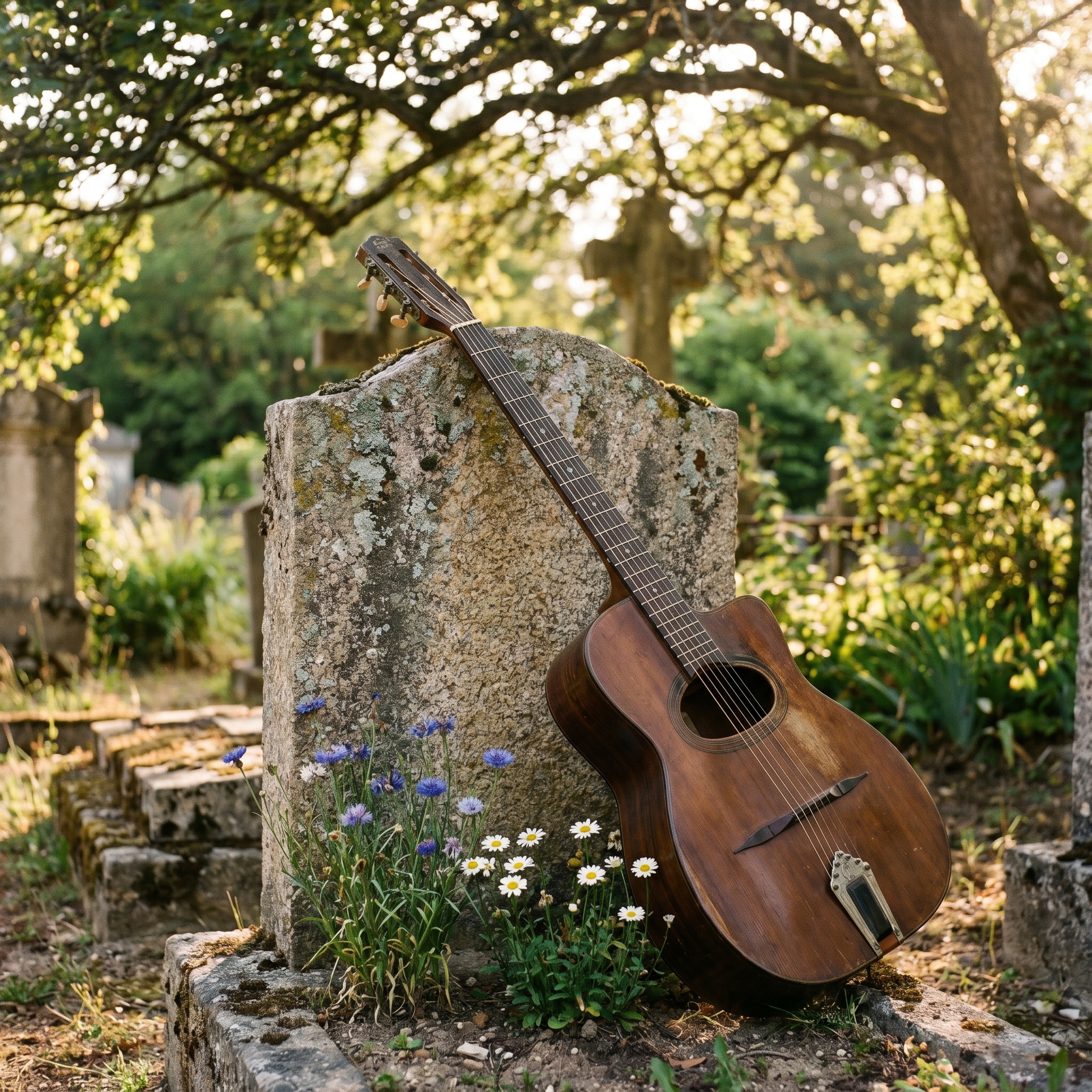
He is buried at Plot V of the Samois-sur-Seine communal cemetery. His wife Sophie joined him there in 1971, his son Babik in 2001, and his brother Joseph – known as Nin-Nin – did too. The grave has become, without a plan, without any signage, and without any cultural funding, one of the most authentic pilgrimage sites in European music. Gypsy guitarists come from the Netherlands, Germany, Hungary, Italy and the United States, and set down their instruments for an impromptu jam session at the grave. It is this pilgrimage movement, It's a family-friendly, community-based, low-key event that will eventually become a festival.
Samois, the ‘Island of the Cradle’, where it all begins
The first public tribute to Django takes place 19 May 1968 in Samois, on the fifteenth anniversary of his death. The newspaper Le Monde The 21 May edition is simply headlined «Django’s legacy celebrated in Samois». The event takes place on Berceau Island, a narrow strip of land in the middle of the Seine, which can be reached via a simple footbridge from the village. At the time, the journalist covering the story spoke of just a simple evening with friends. For an event that is set to go global, that’s not a bad start.
The evening was repeated from time to time, with no fixed frequency, in 1973 and 1978. The Friends of Samois, a local association, are organising increasingly large gatherings: gypsy caravans are beginning to arrive every summer to camping on the banks, playing at night, talking guitar, passing on the pump to their children. The festival doesn’t officially exist yet, but it’s already there, in its infancy, on the island.
It was in 1983 that the project began to take shape. A group of friends and enthusiasts, centred around Jean-François Robinet, a former television presenter and mayor of Samois-sur-Seine, and Maurice Cullaz, president of the Académie de Jazz, filed the articles of association for the Django Reinhardt Festival Association. The official registration is dated 22 July 1983, with its registered office at the town hall, Place de la République. The first annual festival took place the following summer.
A columnist of the time wrote: « It was so rustic, so messy, but so compelling and charming! ». The programme is put together with bits and pieces, the scene is set on the grass, the sound engineers lounge about at their consoles when it rains, and nobody really knows how many people are going to turn up. The festival’s official website preserves this memory of’debonair and assumed amateurism. The format quickly found an audience. One journalist described the event as «smallest of the big festivals». The phrase has become synonymous with the festival and has eventually become – simply because it was too good not to be – an official slogan.
Three decades on Île du Berceau
From 1983 to 2015, the festival was held on the island. It was during this period that its legend was forged. The format evolved, extending from one day to three days, and then to five days from 2010, but DNA doesn’t change: an official stage, where the big names in international jazz take to the stage, and all around – in the campsites, along the paths, right down to the banks of the Seine, jam sessions that never end.
On stage : Stéphane Grappelli (featured from the very first editions, presented by Claude Nougaro), Babik Reinhardt was a regular guest right up until his death in 2001, Stochelo Rosenberg and Biréli Lagrène who are becoming regulars, Tchavolo and Dorado Schmitt, Angelo Debarre, the Boulou brothers and Elios Ferré, Christian Escoudé. On the American side : Chet Baker, Barney Kessel, John McLaughlin, Paco de Lucia. And some more rare but memorable appearances: Toots Thielemans, Didier Lockwood, Sanseverino, Thomas Dutronc.
Off stage, at the campsites, it’s the world Mecca of Gypsy jazz. Entire families are arriving in caravans from the Netherlands, Germany, Italy, Hungary, Spain and the United States. Children learn to pump at six by watching the older generation. Friendships are formed that last a lifetime. Nobody sleeps. It is this sense of community, rather than the headliners, that has earned the festival its international reputation.
Flooding, safety, moving house
The end of the island came without us really seeing it coming, for both practical reasons and reasons to do with the times.
The following year, in January 2017, the decision was made official: the festival is leaving the island for good and moved to Fontainebleau. There were many reasons for this. The flood had shown the vulnerability of a site surrounded by the River Seine, access to which is via a footbridge. The security situation following the attacks requires compliance with Vigipirate standards that an island cannot hold. And the logistics of the festival, which have now grown to accommodate tens of thousands of people, no longer fit within the island’s small-scale framework.
The festival's artistic director, Sébastien Vidal, who has been at the helm since 2006 and is also director of TSF Jazz and the Duc des Lombards, recounts those days. with a candour that is worth noting : « Leaving Île du Berceau, which had been our home since 1968, and leaving behind that artisanal atmosphere, was hard. Everyone feels nostalgic about it. »
The Facebook page of Samois’OFF, a free parallel programme that brought the village to life during the festival, published in 2017 a brief and sad message : «Samois’OFF 2017 is over, and so is the festival. With the festival’s conclusion…» There have been no major controversies in the press, nor any open conflict between Samois Town Hall and the association, but one senses that a certain era is coming to an end.
However – and this is an important point –, The festival has never cut ties with Samois. The festival’s official programme page retains the title «SAMOIS». An opening day in Samois, at Place de la République, will continue to be held from 2018 to 2024. And as for the memory of Django, obviously remains at the cemetery.
The festival in Fontainebleau today
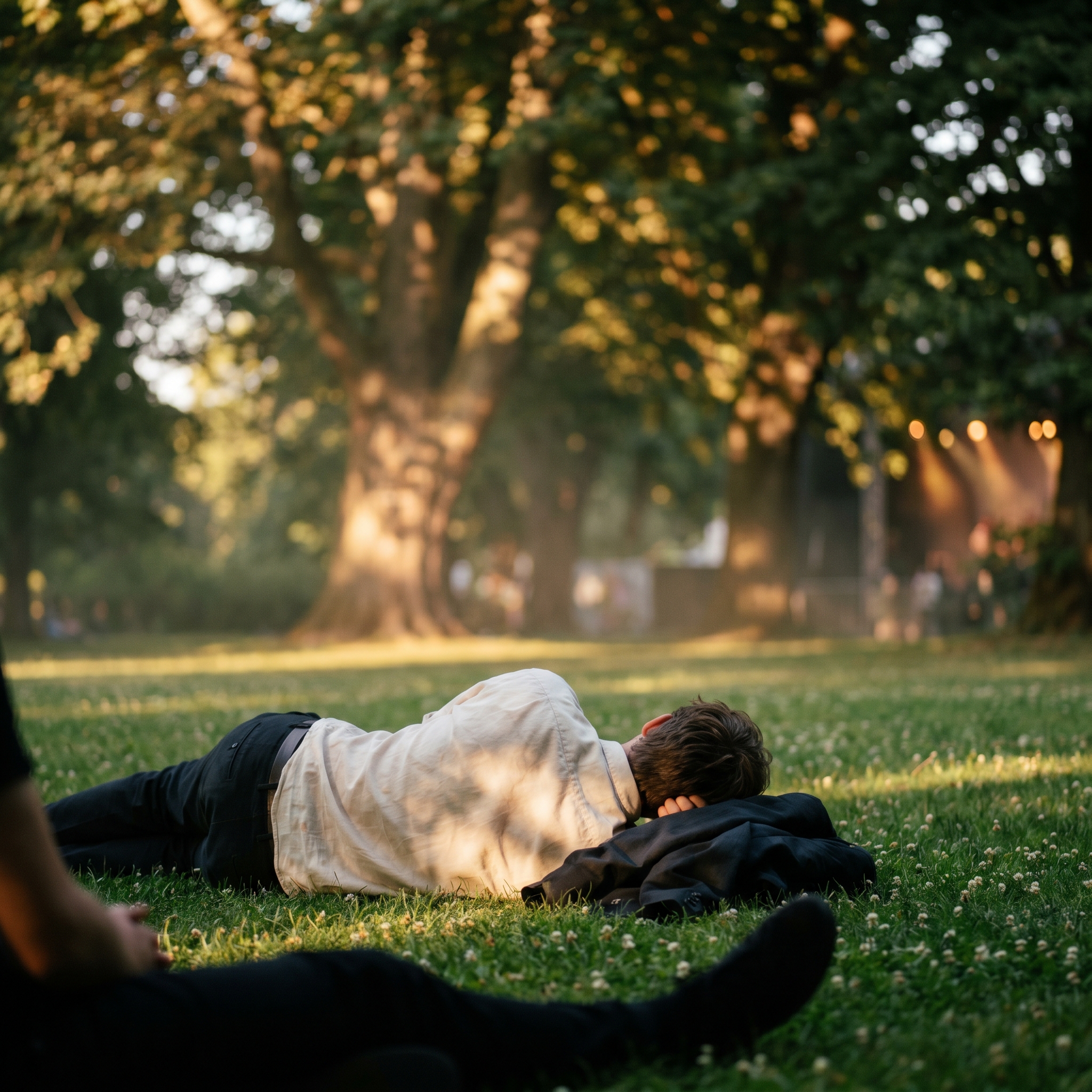 Since 2017, the festival has found its new home in the Bois d’Hyver Meadow, in the grounds of the Château de Fontainebleau, Avenue des Cascades. You enter through a discreet gate opening onto a vast lawn bordered by forest. Two scenes: the Django stage, and the Luthiers' stage, a more intimate event, nestled in the heart of a village home to around twenty instrument makers who had come for four days.
La fiftieth edition, in 2018, heralded the dawn of a new era in grand style, with George Benson, Marcus Miller, Biréli Lagrène, Snarky Puppy, Gary Clark Jr.. The fortieth sequential edition, in 2019, featured Parov Stelar, Ibrahim Maalouf, Thomas Dutronc and Les Esprits Manouches, Tom Misch. Then came the two COVID years which meant the festival could not take place in 2020 and 2021, although, incidentally, no official cancellation announcement has been issued for 2021 (the jump in numbering – from the 40th edition in 2019 to the 42nd edition in 2022 – indirectly confirms this).
Since the return of 2022, the festival has been back on track. a comfortable cruising speed and a line-up that's sure to please the curious music lover. Jamie Cullum, Ibrahim Maalouf, Stochelo Rosenberg, Melody Gardot in 2022. Gregory Porter, Dee Dee Bridgewater, GoGo Penguin, Avishai Cohen, Fatoumata Diawara in 2023, with around twenty thousand spectators over the four days. Melody Gardot, Black Pumas, Rodrigo y Gabriela, Jalen Ngonda, Angelo Debarre in 2024, seventeen thousand spectators. Marcus Miller, Cécile McLorin Salvant, Chucho Valdés, Salif Keita, Kokoroko, AYỌ in 2025.
The challenge of programming has become clearer over the years. The Django stage doesn't just play gypsy jazz. It brings together, under the name of Django, everything in today’s music that still holds true crossover, crossbreeding, swing in the broadest sense of the term. You can hear soul, funk, North American jazz, world music, Brazilian vocals and Israeli folk. And in the middle of this vast panorama, the Luthiers stage continues to carry the historic heart of Gypsy music, featuring the direct heirs, the workshops, the young guitarists taking part in the Tremplin des Luthiers competition, and demonstrations by instrument makers.
Audience profile
The festival was a success that rare thing : it is aimed at both to the historic gypsy audience, who camp or lodge nearby and spend three days on site, to the curious jazz public, who comes for Cécile McLorin Salvant or Avishai Cohen without knowing much about Django, and to the local public, who finds out about the event because he lives a ten-minute walk away. It’s this mix of people that creates the atmosphere at La Prairie: you come across generations, languages, listening styles, all on the same pitch.
The organisation is run by the Django Reinhardt Festival Association, which has its headquarters in stayed in Samois-sur-Seine (rue Victor Chevin). Jean-Pierre Guyard is publishing director, Sébastien Vidal is programming director. for twenty years this year. Institutional support comes mainly from the Région Île-de-France, the Département de Seine-et-Marne, the Ville de Fontainebleau, SACEM and private partners.
The festival in the Gypsy world
 To understand why this festival is not a jazz festival like any other, You have to step aside and look at the world map of gypsy jazz.
There are roughly four or five major international events a year for this very specific musical community. DjangoFest Northwest, in Langley, Washington, is North America’s premier event, held in the autumn in a small island town which, incidentally, is reminiscent of Samois. Django à la Chope, in Brussels, ran from mid-May until it was discontinued in 2022. Smaller gatherings take place in the Netherlands, Germany, Hungary, Italy and even Australia.
But none of these festivals have what Fontainebleau has: the legitimacy of the place. Django lived in Samois, he died there, he is buried there, and his son and brother are buried with him. Although the festival has been moved to Fontainebleau, it still maintains this physical link with the place where the genre’s inventor passed away. It is this geographical legitimacy that leads Manouche families from Amsterdam, Munich and Budapest to regard Fontainebleau as a must at least once in their musical lives.
The other distinctive feature is the transmission size. The festival has never been merely a showcase. The legendary jam sessions in Samois used to fulfil that role. In Fontainebleau, that role is now played by the Luthiers stage, by the Tremplin des Luthiers (a competition reserved for young artists), by the masterclasses by figures such as David Reinhardt, Django’s grandson and a contemporary guitarist, and by the educational workshops organised in collaboration with music schools. This is important: Gypsy jazz is one of the few musical genres that is still passed on almost exclusively by ear, from generation to generation. Without events like Fontainebleau, this chain would be weakened.
Memory, pilgrimage, and the village where everything remains
 If you're coming to the festival from Paris or elsewhere, and you've got two hours to kill on a Sunday morning before the first stage, make a diversion to Samois-sur-Seine. It’s a ten-minute drive from Fontainebleau, and it’s not difficult to get there by public transport either.
In the village, you will find the Foyer Django Reinhardt, At 2 rue Gambetta, a former bakery has been taken over by the local authority and is used as a screening and exhibition room. During the festival week, there is a retrospective photography exhibition on the Samois editions. For the rest of the year, the venue serves as a library and a venue for events.
La Django's house, on Rue du Bas-Samois, still exists. Its current legal status is not publicly documented, and It’s best not to invite yourself along for no reason. Let’s just say you’ll pass it on your way up to the inn, and you’ll know when you see it. As for Chez Fernand, the inn where Django used to entertain, play, paint and where he collapsed, has changed hands several times since 1953. But The banks of the Seine, on the other hand, haven’t really changed.
For older Samois editions, the Médiathèque Municipale de Fontainebleau retains Jean-François Robinet’s reference work, 50 years of the Django Reinhardt Festival: 1968-2018, published to mark the company's fiftieth anniversary. If you want to delve properly into the archives, this is where you should start.
Practical information about the festival
This year’s event is still going ahead end of June, usually in the last week. Four days, from Thursday to Sunday, on the Prairie du Bois d’Hyver, within the grounds of the Château de Fontainebleau, avenue des Cascades. The site is accessible 20 minutes on foot from Fontainebleau-Avon station, through the city centre.
Tickets
There are generally three ticket formats. Four-day pass, which starts at around 135 euros and gives access to both stages for the entire duration. The two-day pass, At around 70 euros, for those who want to make a weekend of it without spending the whole week. Day pass, ranging from 40 to 52 euros depending on the day and the headliners. Admission is free for children under thirteen. The ticket office usually opens at the start of the year, and four-day passes leave quickly when the poster is in high demand.
How to get here
If you’re arriving by train, it’s Fontainebleau-Avon station from Gare de Lyon, in forty minutes. From the station, the château is about a twenty-minute walk along Avenue Franklin Roosevelt, or three bus stations on line 1. If you’re arriving by car, the nearest car park to the venue is the Maréchaux car park, five minutes from the festival entrance.
Where to sleep
Four days at the height of the season, It’s best to start a few weeks in advance Fontainebleau is saturated at the end of June between the festival, the gardens of the Château and the climbing weekends. Two great Fontainebleau addresses just a few minutes' walk from the Château:
- Hôtel de Cavoye - in a four-star 17thᵉ century town house in the heart of the historic centre. Beautifully decorated, spirit private residence, ten minutes' walk from the festival site.
- Hôtel & Spa Napoléon Fontainebleau - A historic address on the main axis of the city centre, spa and indoor pool welcome after a late night of concerts. The in-house restaurant, Le Cadran, This is also an option for dining in the immediate vicinity.
Where to eat between two stages
The festival has its own range of food trucks and stalls on site, but many festival-goers prefer to enjoy the city centre The Château is just ten minutes from Rue Grande. Some good values:
- Inalis - Néobistrot Fontainebleau, 5 rue Montebello, just a stone's throw from the Château. Creative neo-bistro, one of the trendiest restaurants in the city centre.
- Le Cadran - Napoleonic bistro, bistro atmosphere warm Napoleonic décor, perfect for a no-fuss lunch.
- Restaurant Gina, attached to the’Hôtel de Cavoye. Tidy kitchen in the elegant setting of a private mansion, perfect for an evening meal between two days at the festival.
- L'Orée des Sablons - for lunch away from the hustle and bustle of the festival, on the edge of town and the forest. The perfect spot to catch your breath between performances.
- Frédéric Cassel - Tearoom, for a sweet break between two concerts: top-class pastries by chef Cassel.
For a coffee or glass of wine between sets, Happy Curious at 33 place Napoléon Bonaparte is the ideal address: cosy wine café-bar, opposite the Carrousel, just a few minutes from the Château. Open early in the morning and late in the evening.
And if you just want eating on the go without compromising on quality between two scenes, The LOOP is the best street food address in the city centre: fresh bagels and coffee shops, to eat in or take away.
And if it rains on a Saturday
Most of the festival is held under tents and marquees, so a June shower won’t put a spanner in the works. But if you’re planning a day out on a Thursday or Sunday and the weather’s playing up, you can Plan your day with our guide to things to do in Fontainebleau when it’s raining.
To conclude, briefly
The Django Reinhardt Festival survived many things A founder who died at the age of forty-three and whose memory had to be honoured without caricaturing him, a drowning island, a move that could have shattered the magic, two years without a new edition, changes in era and poster design. It’s still there, at the end of July
Some of the establishments mentioned in this article are among the partners supporting Fontyblog.