



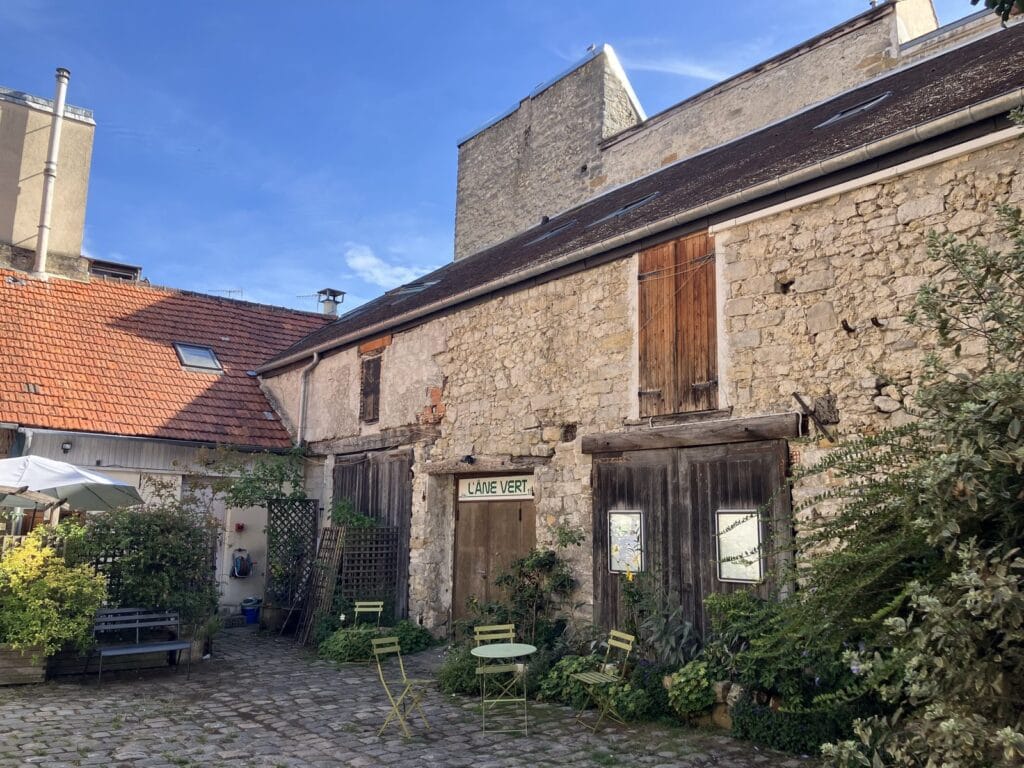
The first article in a new series devoted to portraits.
Here, the character is a place.
A place described by the people who make it what it is.
On Rue des Sablons, between a tea shop and an estate agent’s, there is a wooden carriage entrance and a green sign. You walk underneath it and We’re entering a new century.
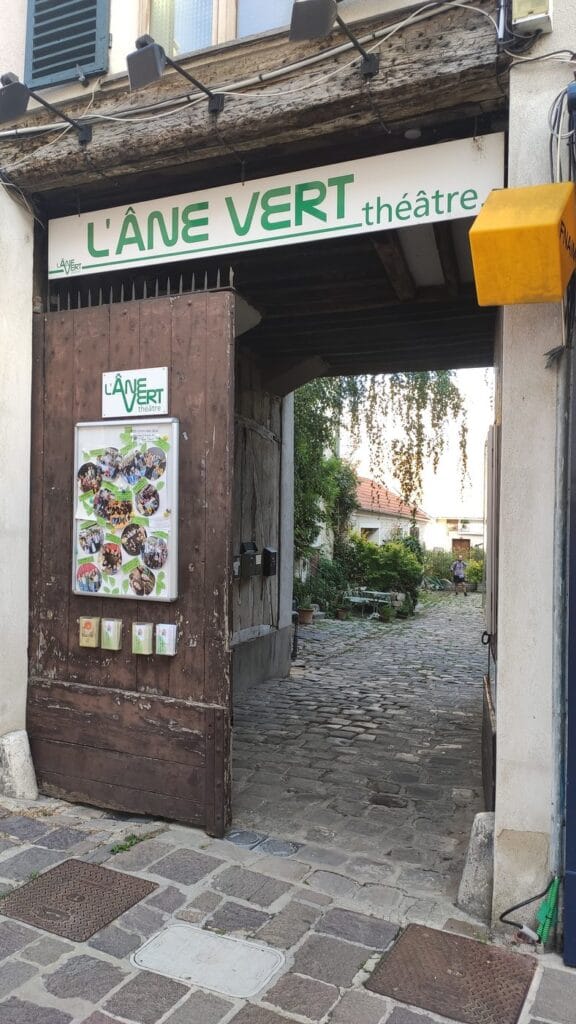
Photo: Emmanuel Parrou / Fontyblog
Behind it, a cobbled courtyard bathed in sunlight, mauve hibiscus, yellow bistro tables, a bicycle leaning against a stone wall. The noise from the street stops abruptly. Marie-Line Grima, who co-runs the place, puts it better than I do.
Whenever I walk through the porch and into the courtyard, I’ve always felt as though I were going somewhere else. As though I were entering another world.
That’s where I was welcomed one Wednesday in September, outside, around a round table. There were three of them: Yves Patrick Grima and Marie-Line Grima, who run the theatre, and Baptiste Bataille, who is in charge of communications and also performs on this stage.
We’d allowed an hour. I left with far more than what I’d come looking for.
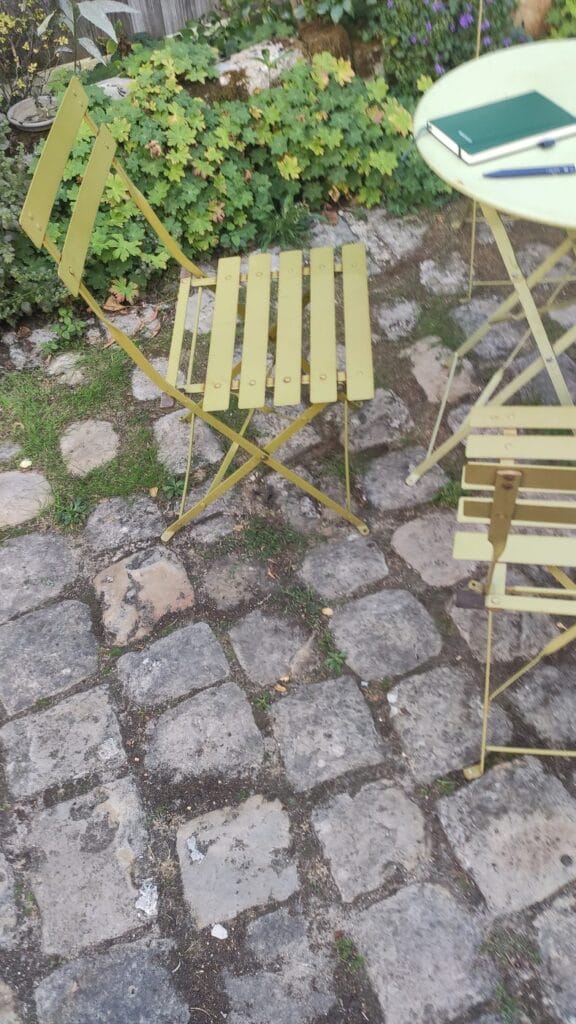
Photo: Emmanuel Parrou / Fontyblog
A green blanket on a donkey’s back
First of all, the name – because we’re all wondering about it.
The buildings date back to the 13th century. Under Louis XII, they housed the town’s first inn. And in the courtyard lived a birch broom maker, who owned some donkeys.
He doesn’t just use these donkeys for work. He hires them out to take ladies for rides. As the ladies wear long dresses and the dresses get dirty, he covers his animals with a green blanket.
In 1523, the brand takes the name of’Auberge de l’Âne Vert.
Five centuries later, it is still there, on the façade, thanks to a roof. The inn has seen its fair share of visitors: Boileau, Mansart, Le Nôtre, d’Alembert, and the jester Triboulet. This is the history of the house, and it is worth telling just as it is.
What remains of the inn is, above all, what you cannot see. The original cobblestones, still lying beneath the concrete slabs. And a large, untreated wooden beam, flush with the floor, whose age nobody knows any more.
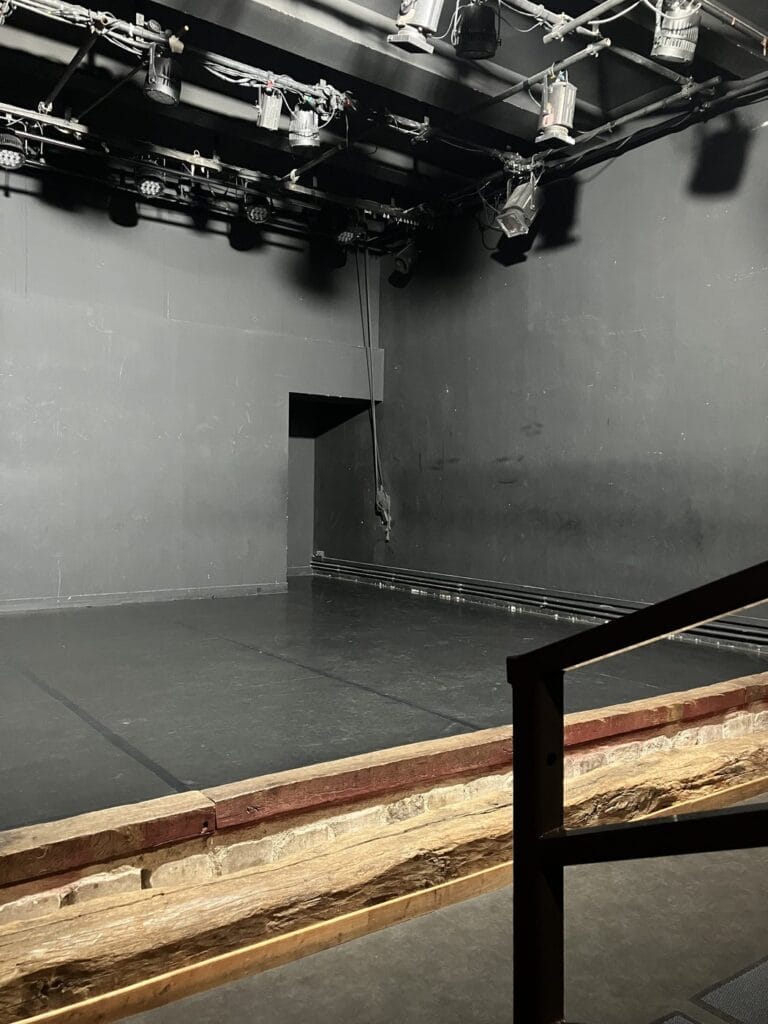
Photo: Âne Vert Théâtre
And seventy-four armchairs
Now, the figure that explains everything else.
The room has seventy-four seats. It’s small. And contrary to what one might easily imagine, it is not an artistic choice.
For me, it’s a constraint.
A financial constraint, to be precise. Because the Green Donkey lives in more than 95 % of its ticket sales. Grants are available, the council provides support, and this support is appreciated. But it does not make up the entire budget.
Do the maths with Yves Patrick Grima.
With the recipe for seventy-four people, you don’t pay for fifteen people.
That is why we should prioritise productions that do not require significant resources (number of actors on stage and sets), but with very high quality standards. This is essential to ensure the long-term future of the artistic work carried out by the Âne Vert Théâtre, which complements the programmes of the larger theatres.
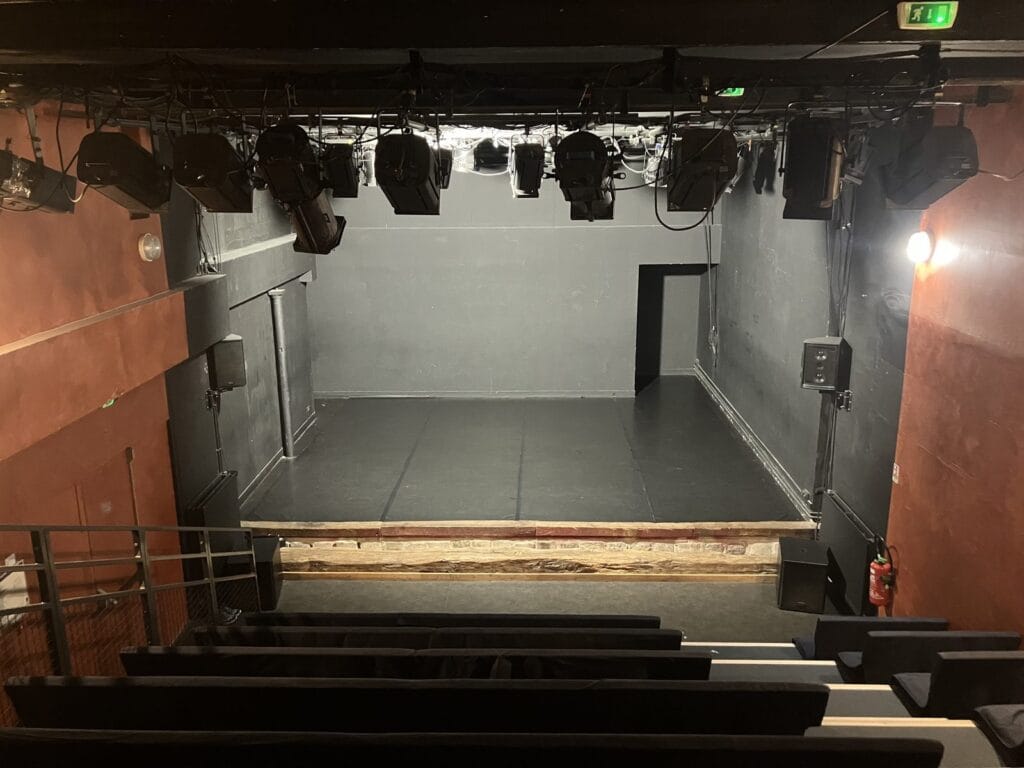
Photo: Âne Vert Théâtre
The other side of the coin, however, lies with the audience. The auditorium is well laid out, the acoustics are excellent – the musicians say so themselves. And we have legroom, which isn’t all that common.
There are theatres where, after a quarter of an hour, you find yourself shifting in your seat every minute.
At seventy-four, something else happens too. The actor sees the audience, and the audience sees the actor breathing. Baptiste Bataille calls this a sense of closeness. Companies visiting from elsewhere notice it.
One hundred and ten sessions a year
What they’ve done with this little room is truly commendable.
A season here lasts about one hundred and ten sessions. On an annual basis, that works out at one every three days, but in practice the season runs from late September to late May. That makes a total of around five thousand five hundred admissions.
Respect.
Around thirty different professional shows every year. A third of these are produced in-house by the Naphralytep theatre company, which is in residence at the venue and chaired by Marian Waddington. The other twenty are sourced from Paris, Avignon, elsewhere in France, and sometimes further afield.
Approximately one fifth of the sessions is aimed at schoolchildren.
And around a hundred spectators are season ticket holders.
The 2026–2027 season kicks off on 26 September with a Jacques Brel and draws to a close at the end of May with a Darling according to Colette. Between the two, Molière, Corneille, Camus, the Peer Gynt works by Ibsen and Brassens, a New Year’s concert, Christmas shows for young audiences, and on 31 December which fills up without anyone having to lift a finger.
This season, there are two events you should make a note of right now, because they’re unlike anything else.
The first one, in January. The ‘Chests of Shame’, about Rose Valland, the curator who secretly catalogued works of art looted during the war. On stage is Pierrette Dupoyet, who has written, directed and performed all her shows solo since 1984, and who has returned to the Avignon Off Festival every year for over forty years.
The second one, in May. A Botanical Daydream with Jean-Jacques Rousseau, played in the courtyard. Not in the hall. In the courtyard, under the hibiscus trees, at 11 am and 4 pm.
That, no other theatre in Fontainebleau cannot offer it.
Three questions for Baptiste Bataille
You started out here as a student. I’d done a workshop with Marie-Line when I was at secondary school. I came back later, as an adult, because I wanted to take it up again. And it was on that occasion that I was offered one of the first projects I starred in.
How many people attend the workshops? Between one hundred and sixty and one hundred and eighty members every year. Fifteen workshops, including three in English, performed by seven actors. It starts at the age of five and it never really stops. In June, each group presents the work they’ve done over the year on stage – these are the workshop festivals.
‘Amateur’ – is that a word that makes people uncomfortable? Not at all, and that’s precisely why it’s ambiguous. You can perform at an excellent standard as an amateur your whole life. We have some excellent ones. The transition to the professional level isn’t a question of talent; it’s a question of status and the number of performances. This year, the Nouveaux Tréteaux theatre company is staging The Extras, by Delphine de Vigan, on 7 and 8 November.
The show we must defend
I ask them if there is a show in this season’s programme that they would recommend above all others.
Yves Patrick Grima refuses to choose. Then he turns the question round, and his answer is one of the most powerful I heard that afternoon.
The show that deserves to be highlighted is precisely the one that is of high quality, but whose title lacks the elements needed to capture the audience’s attention.
In other words: the show we must defend is the one in which The title doesn’t mean anything to anyone.
Baptiste Bataille adds.
Every year, there are some really good shows that attract slightly smaller audiences because the title isn’t well known, because the writer isn’t well known, and because the theatre company isn’t either. And that’s a shame. There’s a real effort to be made to explain the show properly and make people want to come along.
One example, among many. They brought in a company based in Milan featuring a dance performance in French and Italian, exploring intergenerational solidarity and migration. A production that was a challenge to stage, with actors needing accommodation for several nights. A show that deserved a bigger audience than it actually had.
When you put Molière on the programme, everyone knows what to expect. But when you put a Milanese theatre company on the programme that nobody’s heard of, you’ve got to tell people about it. That’s exactly when a theatre needs people to talk about it in ways other than just through a poster.
The room, when it’s all over
I ask them if they have a favourite spot here.
Yves Patrick replies, ‘The theatre,’ without hesitation. Marie-Line replies, ‘The theatre,’ and ‘the stage’.
Once all the performances have finished, you’re free to wander back into the theatre on your own. And all the vibrations from the performances blend together.
There’s a spirit in this room.
Seventy-four armchairs, a courtyard, a beam whose age no one knows, and five centuries that begin with a green blanket on a donkey’s back.
Seventy-four armchairs, and evenings to be enjoyed, emotions to take home with you.
Seventy-four armchairs.
Seventy-four seats.
Yours?
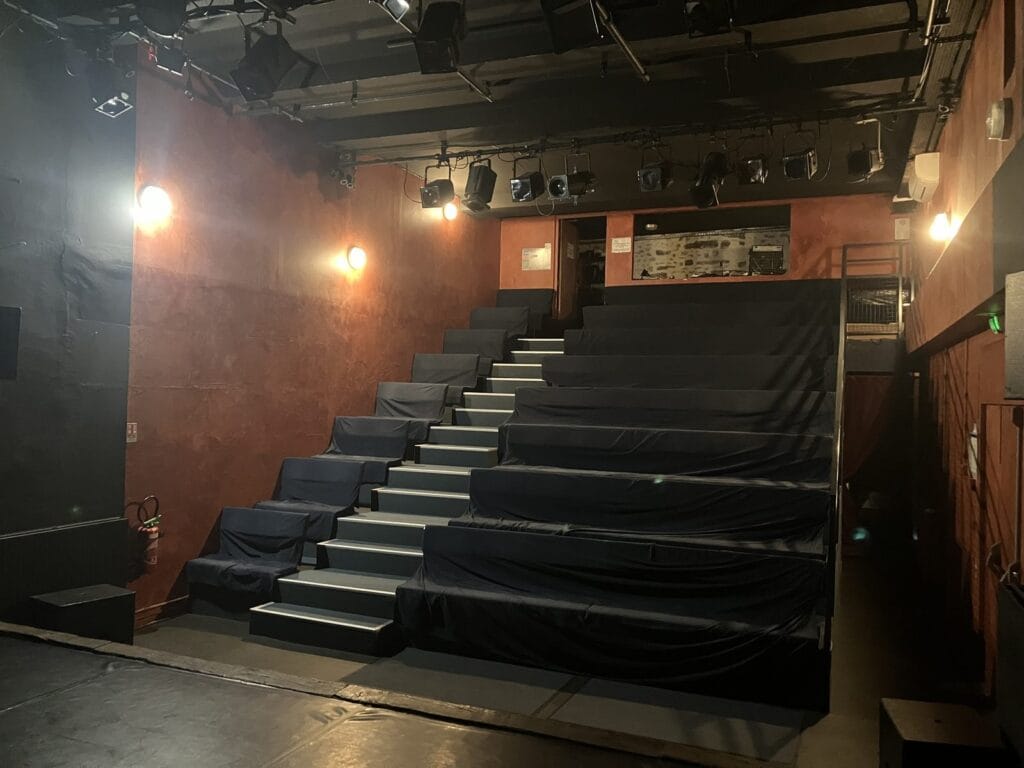
Photo: Âne Vert Théâtre
In practice
L’Âne Vert Theatre, 6 rue des Sablons, 77300 Fontainebleau. Programme and bookings at anevert.fr. The full programme of upcoming events is updated weekly on the Âne Vert Théâtre page on Fontyblog, and in the website’s calendar.
Prices. €21 per ticket. Concessionary rate of €14 for jobseekers and those on minimum income support. Special rates for children’s shows. Groups of ten or more: €17 per person.
The membership card. You commit to three shows this season, paid for in advance at €17 each. The pass then entitles you to the €17 rate on all other shows throughout the year, with no limit.
Three organisations, one location. L’Âne Vert Théâtre is the venue. The professional theatre company Naphralytep is in residence there and stages an average of ten shows per season, a good third of which are new productions, with the remaining two-thirds being revivals. Les Nouveaux Tréteaux de l’Âne Vert (ntav.fr) runs the fifteen practical workshops. And the association Les Oreilles de l’Âne Vert, OrÂne (oranevert.fr), programmes two shows per season.
Théâtra’Bleau. Twelve days of the festival, organised jointly by the three organisations, featuring shows for young audiences, artistic walks performed around the town by workshop participants, and a grand evening event at the Municipal theatre. The dates for the next event have not yet been finalised.