


The Fontainebleau forest is waiting for you
Since 22 August 2026, most of the forest has reopened: Franchard, Le Cuvier and most of Apremont are welcoming walkers and climbers again. A few areas remain closed for everyone's safety, and they are signposted on site.
Where to go today? The ONF map and practical information are on our page Access to the Fontainebleau forest. For climbing, Which boulders are open? lists everything that is climbable, sector by sector and boulder by boulder. And to follow the news day by day, head to The Kiosk, our live news feed.
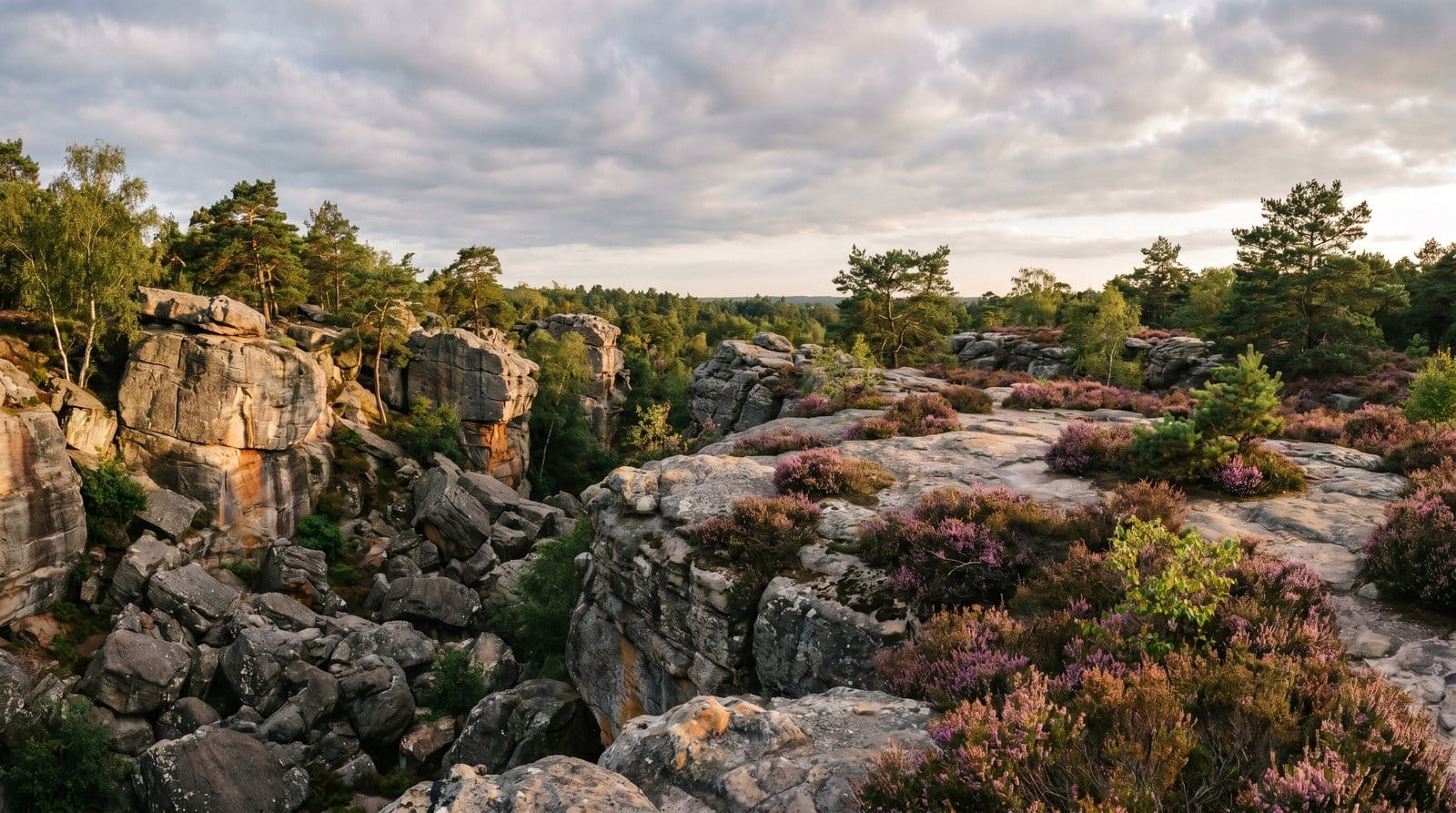
We all have our own gateway to the Forest of Fontainebleau: a rock where we learnt to climb, a blue trail we followed one autumn Sunday, a stag spotted at dusk. Just 40 minutes from Paris, this massif of sandstone and sand is one of the most beautiful in France, and by far the most popular. Here’s what you need to know to understand it – and, above all, to choose where to start.
What brings you to the forest?
A royal forest turned playground
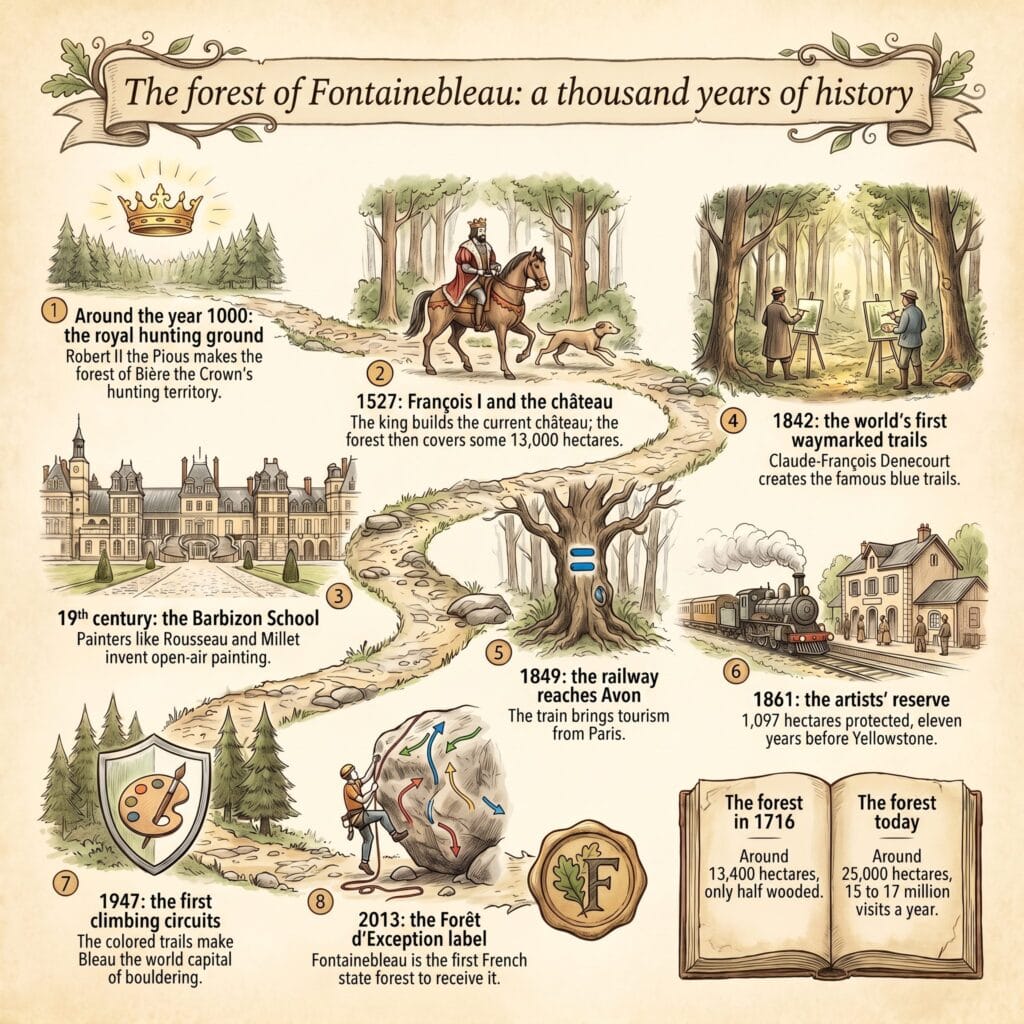
Before it became ours, the forest belonged to the kings. A hunting ground from the year 1000 onwards, it took on its present form under Francis Ier and its castle. Henri IV laid out the Route Ronde, a 26 km route to follow the hunts by coach. But the real turning point came more recently, in the 19th century.e In the 19th century, the Barbizon painters (Théodore Rousseau, Jean-François Millet) set up their easels in the heart of the countryside and devised a new way of looking at the landscape. In 1842, a former soldier in Napoleon’s army, Claude-François Denecourt, marked out the world’s very first signposted trails here – his famous «blue trails». The arrival of the railway in Avon in 1849 did the rest: the forest became a weekend getaway for Parisians. It has remained so ever since.
Sandstone, sand and chaos
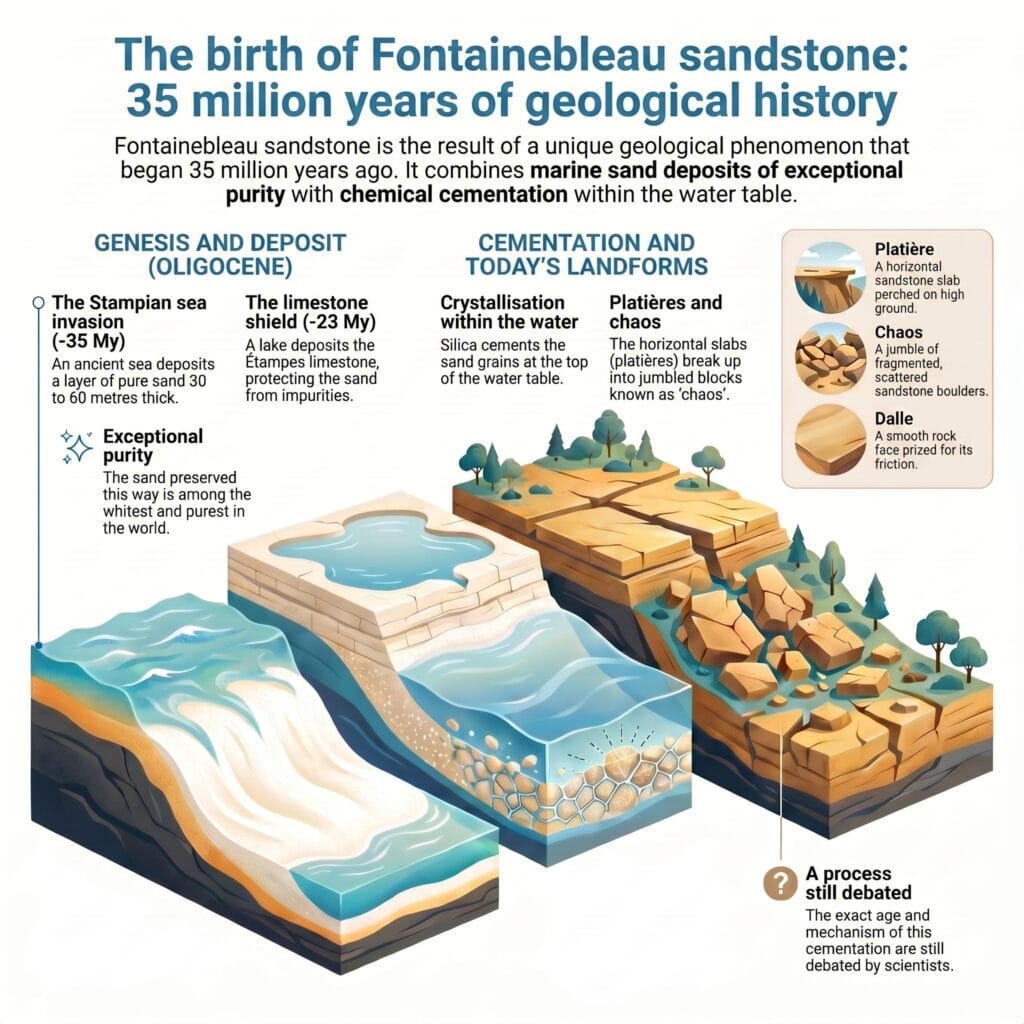
If the landscapes of Fontainebleau are unlike any others in Île-de-France, it is down to geology. Around 35 million years ago, a sea deposited thick layers of very pure sand here. Some of this sand cemented together to form sandstone banks, which erosion subsequently fractured into a jumble of boulders and carved into plateaux – those perched rocky slabs where water pools in small ponds. The result: spectacular gorges, «seas of sand» such as at Cul du Chien, and this very distinctive sandstone – both striking and fragile – which has earned the massif its worldwide reputation.
' Coming soon: our complete guide to the geology of Fontainebleau (page coming soon).
Biodiversity that has to be earned
You might think you’re walking through a peaceful forest; in reality, you’re passing through one of Europe’s biodiversity hotspots, home to over 5,600 plant species and nearly 6,000 animal species. There are hundreds of red deer, roe deer and wild boar here; they are shy creatures, most often seen at dawn. The heather-covered moors are home to rare birds such as the subalpine warbler, whilst the ancient trees in the nature reserves provide shelter for insects found almost nowhere else. To help you learn to interpret these signs, the Tourist Office organises some wonderful guided walks, on the trail of animals in the forest or discovering Franchard's biodiversity.
› Coming soon: our feature on the forest’s flora and fauna (page coming soon).
The global home of bouldering
It was here, at «Bleau», that bouldering was born. As early as the late 19th centurye In the 19th century, mountaineers would come to train on the boulders before setting off for the Alps; climbing then became a discipline in its own right, with its colour-coded routes devised locally (and copied all over the world). Today, nearly 500,000 climbers come every year to test their skills on the sandstone of Apremont, Le Cuvier or Les Trois Pignons. Never tried it? The Tourist Office organises introductory bouldering sessions for a safe start.
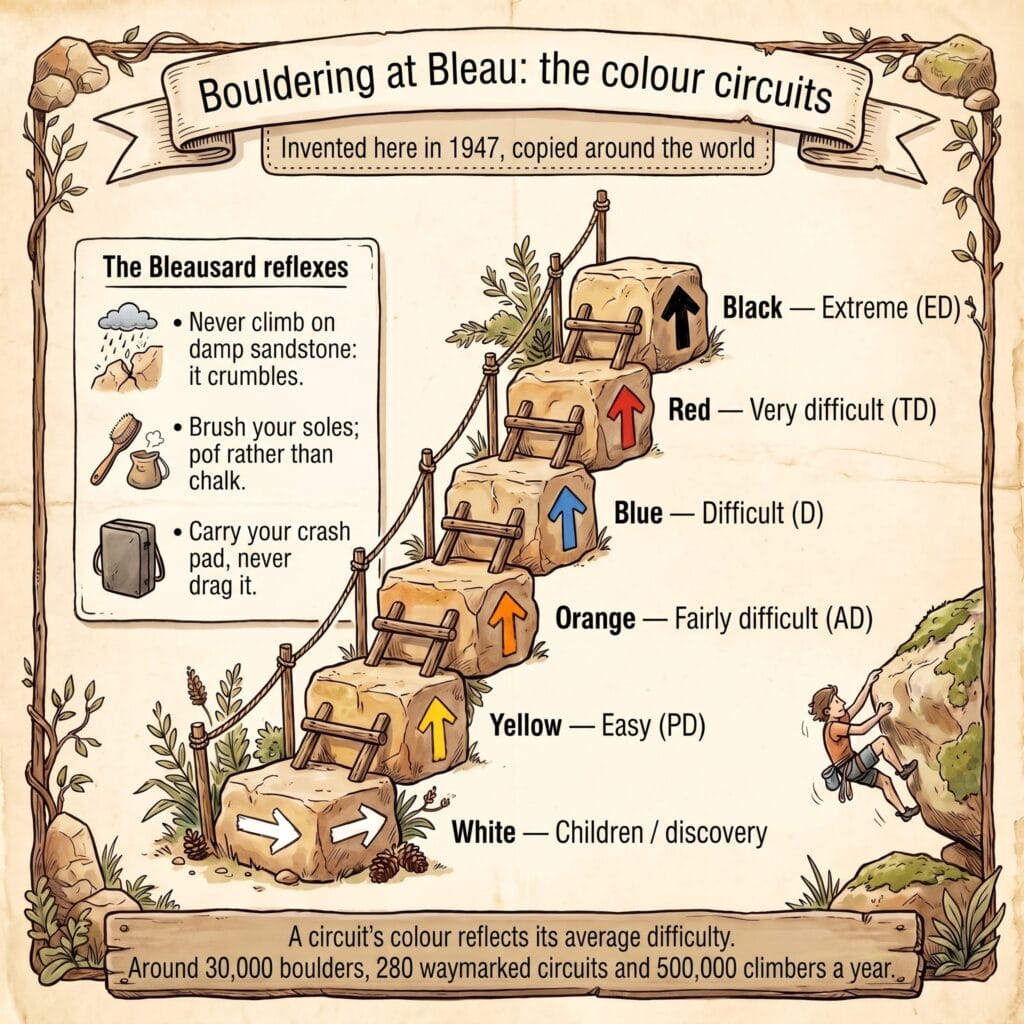
› Where to climb today? Every open sector and boulder, on our live map: Which boulders are open?
Hundreds of kilometres of trails
The forest boasts nearly 300 km of signposted trails maintained by the Friends of the Forest: the blue trails at Denecourt for adventure, the yellow trails (six of which are accessible by pushchair or wheelchair) for easy walks, and the ‘25 Bosses’ circuit for those with strong legs. From the Family storytelling walk to a complete tour of the massif over several days, there's something for every calf.
' Coming soon: our guide to walks in the forest of Fontainebleau (page coming soon).
Where to start?
- Gorges de Franchard A postcard landscape of chaos and moorland.
- Apremont Gorges Rocks of astonishing shapes, starting from Barbizon.
- Les Trois Pignons : the Cul du Chien sea of sand and the capital of bouldering. Part of the area is closed this season, so check the map of open boulders before setting off.
- The Denecourt Tower A 360° viewpoint, accessible on foot from the station.
- Mount Ussy The most beautiful walk«, said Denecourt himself.
Practical info
Getting there : R line train from Paris Gare de Lyon, 40 mins to Fontainebleau-Avon (and there’s even a «Fontainebleau-Forêt» stop right in the heart of the forest at weekends). By car, car parks serve the main attractions (Franchard, Apremont, Trois Pignons).
Good to know : Overnight parking is prohibited in the forest car parks. Autumn and winter are the best seasons for climbing, when the sandstone is «sticky».
Preserving the forest
15 to 17 million visitors a year – that takes its toll. A few tips from the locals: stay on the paths, don’t climb on wet sandstone (it crumbles), keep your dog on a lead from 15 April to 30 June, no fires or camping outside the designated areas, and take your rubbish away with you. The forest will thank us for it.
See also
Which boulders are open?
Getting to Fontainebleau
Parking in Fontainebleau
An introduction to bouldering
In the footsteps of animals
Storytelling walk
Biodiversity in Franchard
Military Riding School
Yoga in the forest
Frequently asked questions
How big is the forest of Fontainebleau?
Approximately 25,000 ha, of which nearly 22,000 ha are state-owned forests managed by the ONF (the Fontainebleau, Trois Pignons and Commanderie forests).
How do you get there without a car?
By train, on the R line, it takes around 40 minutes from Paris Gare de Lyon to Fontainebleau-Avon station. There’s even a «Fontainebleau-Forêt» stop that takes you right into the heart of the forest at weekends.
Can you go rock climbing if you’re a beginner?
Yes. The forest has plenty of easy sections (Roche aux Sabots, yellow trails), and the Tourist Office offers guided introductory sessions.
Are you allowed to pick mushrooms?
Yes, for family use, up to a limit of 5 litres per person per day in state-owned forests. Resale is prohibited.
Are there any walks that are accessible for pushchairs or wheelchairs?
Yes, 6 yellow paths have been adapted for people with reduced mobility (Faisanderie, Arboretum, Mare aux Évées...).