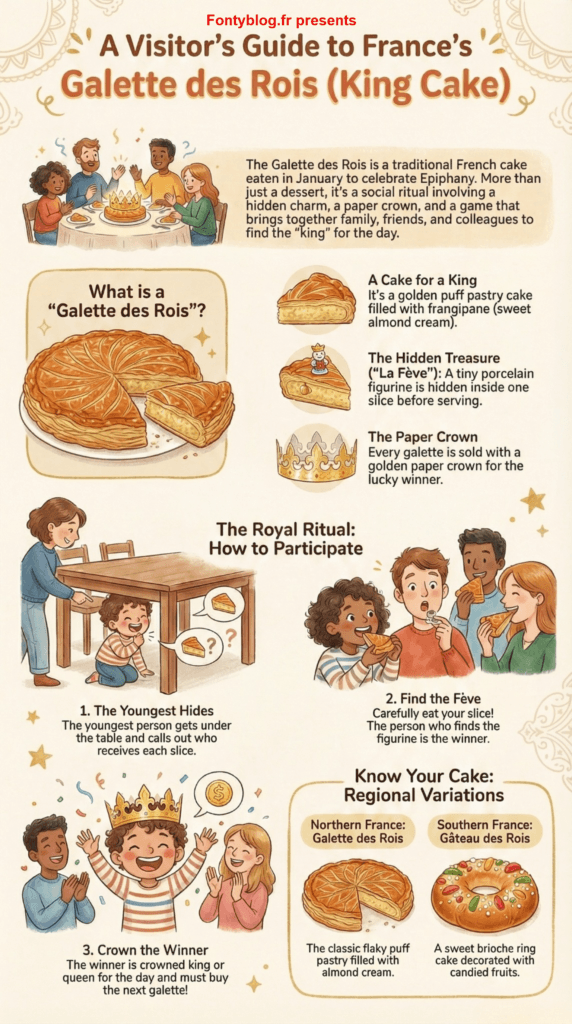



La galette des rois is a traditional French pastry eaten during the Epiphany period to celebrate the visit of the Three Wise Men to the baby Jesus. This golden puff pastry cake filled with frangipane (almond cream) is much more than just a dessert: it is a much-loved ritual that brings people together. families, friends and colleagues throughout the month of January.
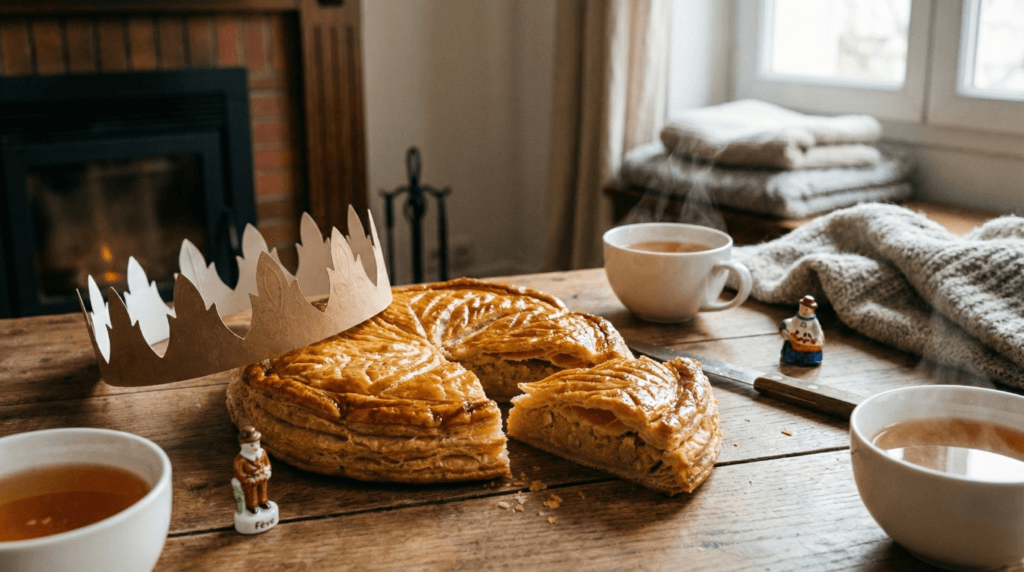
The tradition revolves around a small hidden object called bean (originally a dried bean, now usually a small porcelain figurine) baked inside the cake. The person who finds the bean in their slice becomes king or queen for the day and wears a golden paper crown provided with each galette.
When do we eat the galette des rois?
The galette des rois is traditionally eaten on Epiphany, the 6 January, which marks the end of the Christmas period in the Christian calendar. However, French bakeries begin selling galettes as early as end of December and throughout the month of January, and it is common to share several of them with different groups: family, colleagues, friends.
In France, January has truly become the «season of pancakes», and you will find these pastries in almost all bakeries and pastry shops of the country. Many companies organise a convivial gathering around a galette des rois as a festive way to start the new year.
How does the tradition unfold?
Tradition follows a ritual both simple and charming. The galette is cut into as many pieces as there are guests, plus one extra piece called «the poor man's share» or «God's share», traditionally set aside for the first poor person who might knock on the door.
The most young child The presenter stands under the table and, without seeing the cake, calls out names to designate who receives each slice. This ensures an even distribution. random and fair. The person who finds the bean in their slice becomes the king or the queen, wears the crown, and must traditionally buy the next galette or choose his queen or king to reign alongside him.
Origins and history
The tradition dates back to the’Roman antiquity, with the feast of Saturnalia, during which a bean hidden in a cake designated a symbolic king for the day. The’Catholic Church Christianised this custom, linking it to the’Epiphany and the Three Wise Men bringing gifts to Jesus.
The modern galette as we know it — puff pastry furnished with almond cream — became popular in Paris and in the northern France in the XIXe century. In the southern France, there is a different version: the king cake, a crown-shaped brioche decorated with candied fruit, similar to King's cake Spanish.
Regional variations
In the northern France, the galette is made of puff pastry and garnished with frangipane (almond cream, sometimes mixed with pastry cream). In the south, particularly in Provence, we prefer the king cake : one brioche ring-shaped decorated with candied fruit and from pearl sugar.
Similar traditions around the world
This celebration is not unique to France. Similar customs exist in different cultures, often linked to Epiphany or the transition to the new year.
- Spain and Latin America the King's cake is a ring-shaped brioche eaten on 6 January, often filled with cream and decorated with candied fruit.
- Portugal the bolo rei (king cake) is similar to the Spanish version, with a brioche filled with candied fruit and dried fruit.
- New Orleans, United States the King Cake is eaten during the season of Shrove Tuesday (from Epiphany to Shrove Tuesday), decorated with icing violet, green and golden.
- Belgium and the Netherlands : there are also Epiphany cakes with a bean hidden inside.
- Greece : the vasilopita is cut on New Year's Day with a coin hidden inside to bring good luck.
The phenomenon of collecting figurines
What began as a simple bean has become a real collecting phenomenon. Modern beans are tiny. porcelain figurines representing all kinds of themes: cartoon characters, historical figures, animals, monuments, limited editions, etc.
Many French people like collect these small pieces, and some rare beans can increase in value. Bakeries often create limited edition series, and specialist manufacturers produce thousands of models different.
Cultural significance today
The galette des rois illustrates the French art of celebrating simple pleasures through the gastronomy. She embodies the values of sharing, from’equality (thanks to the random distribution of the bean) and friendliness. In businesses, schools and homes, it provides a moment to gather, chat, laugh and enjoy a sweet treat during the day. cold and winter January.
For the international students at INSEAD in Fontainebleau, participating in this tradition is a way of both playful and delicious to discover the French culture. Many local bakeries around Fontainebleau offer their own versions of the galette throughout January, and it has become common for student societies and companies to organise galette parties as a team-building and social activity.