



Introduction
You're probably familiar with the majestic horseshoe-shaped staircase at the Château de Fontainebleau, but did you know that to its left hides a veritable treasure trove of history ?
The oldest sports hall in the world still in operation awaits you for a fascinating discovery...
La Salle de Jeu de Paume, Fontainebleau is a hidden treasure at the heart of the famous château de Fontainebleau. Built during the reign of Henri IV in 1601, this historic hall is recognised as one of the world's most important museums. the oldest sports hall in the world. It embodies not only the spirit of the games of the period, but also the evolution of a sport that shaped royal leisure activities.
The historical importance of this site extends far beyond its walls. It has witnessed games and sporting competitions that have captivated sovereigns.
The heritage of the game is rich and varied. It's not just a sport, it's an integral part of our culture. The venue continues to attract those interested in discovering the living history of the game. jeu de paume at Fontainebleau while learning about this historic sport.
History and development of jeu de paume in Fontainebleau
The Salle de Jeu de Paume at Fontainebleau has a fascinating history, rooted in France's royal heritage.
1. Built by Henri IV
Built in 1601 under the reign of Henri IV, the hall has undergone various renovations over the centuries, testifying to the continuing importance of the site. The venue was designed to host this noble sport, which is both entertaining and competitive.
2. Use by famous French sovereigns
Henri IV, the passionate king
- He was constantly "stuffed in the palm room".
- The king could be seen playing in a "torn shirt", such was his enthusiasm for the game.
- The day after his triumphal entry into Paris in 1594, he went to play paume to show himself to the public.
- His mistress Gabrielle d'Estrées often came to watch him play.
Louis XIII, the sporting heir
- He had been practising this sport since childhood
- He had a hall built near Versailles in 1630 so that he could play more regularly.
- He continued his father's tradition by playing regularly at Fontainebleau.
Louis XIV, the change of era
- In his youth, he played in the Fontainebleau auditorium.
- Later, because of health problems, he could no longer play but turned the game into a court show.
- He would bring in the best master hacksmiths to give demonstrations for the court during visits to Fontainebleau.
Napoleon...
- ... only played there once: legend has it that he was so bad he never came back!
Their presence not only enhanced the prestige of the game, but also contributed to its evolution within French royal history.
3. The origins of hand-to-hand gambling
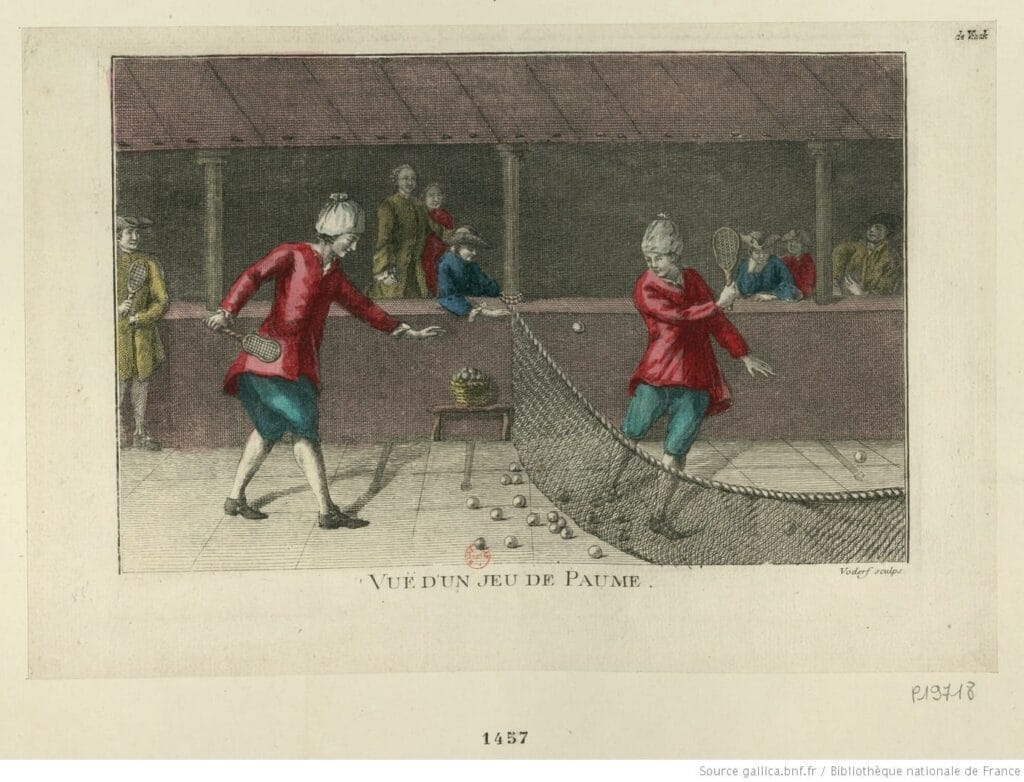
The roots of the game go back to the Middle Ages, when it was played bare-handed. It was not until the 15th century that the introduction of rackets marked a significant turning point. This technical evolution allowed for a richer and more varied game dynamic.
4. Transition to modern tennis
Over time, the game of paume evolved into the rules and formats we know today in modern tennis. This transformation took place gradually, but was influenced by the growing popularity of the sport across Europe.
5. Role of the Cercle du Jeu de Paume
The Cercle plays an essential role in preserving and promoting the game. By organising regular events and initiations, it ensures that this age-old tradition is kept alive.
6. National and international competitions
The First World Championship
- In 1740, the Fontainebleau auditorium hosted a historic event: the very first World Championship in the history of the sport
- France's Clergé de Elder becomes the first official world champion
Modern competitions
- More recently, the hall has hosted:Women's world championships
- Regular international competitions thanks to recent renovations
- Matches as part of the twinning with Hampton Court Castle in England
As you can see, Fontainebleau's jeu de paume hall, although built in 1601 and considered to be the oldest sports hall in the world, is still in use today and continues to host major competitions more than four centuries after its construction!
Introduction to and practice of jeu de paume at Fontainebleau
Learning to play jeu de paume in Fontainebleau is a rewarding and accessible experience. Here is some practical information to get you started:
- Course booking To take part in an introductory course in jeu de paume, simply contact the Cercle du Jeu de Paume. You can reserve your place by calling 01 64 22 47 67. Sessions are suitable for beginners.
- Master paumier Each course is led by an experienced peacock master, who will guide you through the fundamental techniques of the sport while sharing the fascinating history of the place.
Benefits of learning this historic sport
- Physical activity The game is a great way to keep active and have fun at the same time. It builds endurance, coordination and concentration.
- Cultural immersion When you learn this sport, you immerse yourself in a centuries-old French tradition. It creates a unique link with local history and culture.
- Competitions Competitions: you also have the opportunity to take part in competitions organised throughout the year, adding an exciting dimension to your learning.
Taking up jeu de paume at Fontainebleau is not just a sporting choice, it's an immersion in a living heritage.
An egalitarian mixed sport: the case of jeu de paume
Jeu de paume has a distinctive character mixed and its early openness to female participation. Since the 15th century, this royal sport has welcomed players such as Margot d'Hainaut, who left her mark on history.
The Salle de Jeu de Paume in Fontainebleau is a powerful symbol. The tournaments held there, organised by the Cercle Jeu de Paume, not only perpetuate tradition but also reinforce the idea that this sport can bring together all enthusiasts, regardless of gender or social status. This iconic venue doesn't just celebrate the past; it also encourages an inclusive and dynamic future for all players!
The sporting and cultural heritage of jeu de paume in France
Jeu de paume, a true symbol of France's sporting heritage, occupies a unique place in the history of leisure activities. This ancient sport, which evolved into modern tennis, has been part of French culture for centuries.
Passing on these values and skills will ensure that the game continues to be a pillar of France's sporting heritage. What's more, the game fosters links between generations, bringing together enthusiasts and novices around the same passion.
What can you do at the Château de Fontainebleau?
The Château de Fontainebleau, a true historical gem, is not limited to its emblematic Salle de Jeu de Paume. Here are a few activities to discover during your visit:
- Visit to the royal flats History: immerse yourself in history as you explore the sumptuous flats that once housed the kings and queens of France.
- A walk in the park Enjoy a stroll in the vast park, ideal for admiring nature and the formal gardens.
- Temporary exhibitions exhibitions: find out about current exhibitions highlighting the art and history of the site.
- Walk around the castle Marked trails await you for total immersion in the surrounding forest.
For an original and unusual experience, consider :
- A royal picnic Bring a meal and enjoy a convivial moment in one of the park's green spaces.
- Introduction to jeu de paume workshop Introduction to this historic sport and its unique atmosphere.
- Visit the castle by night Some evenings offer guided tours under the stars, offering a fascinating perspective on this monument.
Whether you're a history buff or just curious, the Château de Fontainebleau is packed with exciting activities to suit all tastes.
Conclusion
The Salle de Jeu de Paume in Fontainebleau is a treasure to be discovered. This historic sport is not just a physical activity, it's also a symbol of a culture of peace. cultural heritage rich. By visiting this iconic venue, you can immerse yourself in the fascinating history of the game, while enjoying a unique atmosphere.
Don't hesitate to book your session and become part of this living tradition. Whether you're a novice or an enthusiast, the experience awaits you in the heart of Fontainebleau!
For those wishing to explore more of the city and its historical treasures while enjoying comfortable accommodation, it is possible to book a modern studio in the heart of Fontainebleau.
Frequently asked questions
What is the Salle de Jeu de Paume de Fontainebleau?
The Salle de Jeu de Paume in Fontainebleau is the oldest sports hall in the world, built by Henri IV in 1601. It is an important historic venue for jeu de paume, an ancient sport that has evolved into modern tennis.
What historical events are linked to the Salle de Jeu de Paume?
The hall has been used by several famous French sovereigns, including Henri IV, Napoleon and Louis XIV. It has also played a central role in the history of jeu de paume, with national and international competitions organised over the centuries.
How can I take part in an introductory course in table tennis?
To take part in introductory lessons in jeu de paume in Fontainebleau, we recommend you book ahead (01 64 22 47 67). These courses offer an excellent opportunity to learn this historic sport while having fun.
Is jeu de paume a mixed sport?
Yes, jeu de paume has been a mixed sport since the 15th century, with early recognition of women in this field. This bears witness to a significant cultural and social impact on the sport.
What is the cultural impact of jeu de paume in France?
Jeu de paume is of major cultural importance in France, representing a rich sporting heritage. The traditions of the game live on today thanks to living testimonies and initiatives aimed at preserving this heritage.
What other activities are available at the Château de Fontainebleau?
As well as the jeu de paume, the Château de Fontainebleau offers a range of activities including guided tours, art exhibitions and cultural events. There are also suggestions for exploring the château in an original and unusual way.